Tuesday, 6 December 2011

Sailing through a rainforest!

World looked well again after a long sleep. Most of the passengers had been overtired when they arrived yesterday after their very long flights. MV FRAM was sailing through the Beagle Channel during the night and the soft movement of the vessel let us sleep like a baby in a cradle.

We cruised in the “Canal Cockburn” already in the morning when we went for our first breakfast of the trip. The landscape looked amazing. The hills have been soft shaped as they have been eroded by the glaciers during the last ice age, more than 10.000 years ago. Some of them even had no vegetation, they looked really grey polished.
Later on the rocks were covered with the South Chilean Beech forest. As this forest is a rain forest - in some regions of the Chilean Fjords we have more than 6.000mm of rain during the year - it is no wonder that we had deep hanging clouds and a little bit of rain. In the background we could see the snow covered Mountains.


The sharper Peaks have never been covered with ice, even not during the ice age. These so called “Nunataker” have been exposed above the former ice shield.


During lunchtime we sailed through the “Seno Magdalena” into the “Estrecho de Magallanes”. The wind blew up so that we had white crowns on the waves. At this moment we got the first impression what it means to be on a ship.


Already during the morning we started our lecture series focused on Patagonia and Tierra del Fuego. After a short rest during lunch the lecturers tried again to make Patagonian specialists out of us. But of course we wanted to be best prepared for our landings in this region.

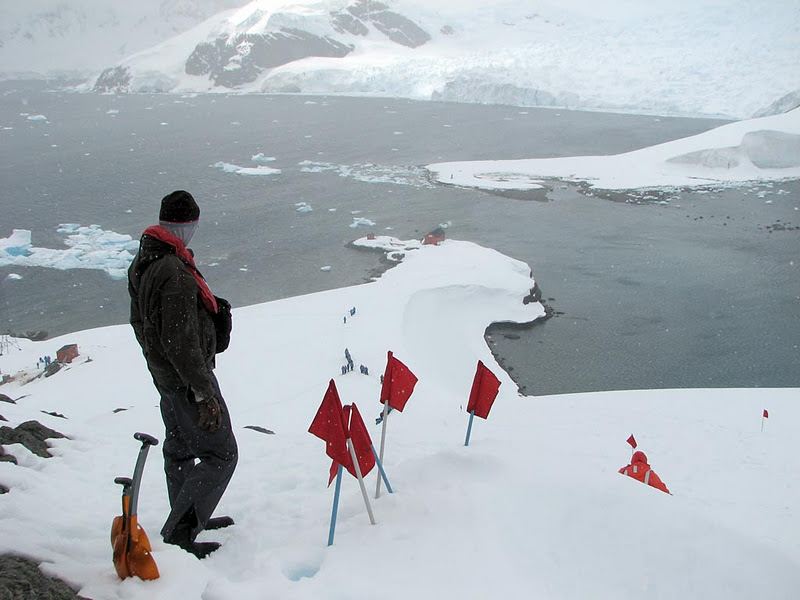
Around 6pm we went alongside in Punta Arenas. The wind was very strong at this time, but the wind had blown the clouds away so that we had blue sky with sunshine at least in the evening. After the ship has been cleared into Chile by the officinals first those passengers, who booked the Torres del Paine tour had to leave the ship. Shortly afterwards all passengers could leave the vessel to enjoy Punta Arenas at night.

Springtime in the far south

That’s what we experienced today in Ushuaia, the most southerly city in the world. It rained all morning and the brilliant sun came out in the afternoon. Spring is very variable here! We arrived in Ushuaia early this morning and after breakfast our passengers of the last two weeks said goodbye and went their various ways- local excursions, elsewhere in South America or directly home. Then the Fram lay quiet for a few hours although this calm belied the real situation: one of cleaning, taking on provisions, taking on fuel, and generally preparing for our next passengers to arrive later in the day. Ships are very expensive to run and they do not lay idle for very long!


Ushuaia is a fascinating city, so far south, but so dynamic and vibrant. With the Andes mountains as a backdrop, and the special architecture, you could imagine yourself somewhere in Europe. The city has developed rapidly with the help of tax incentives and subsidies from the Argentine government and the growth in the Antarctic cruise industry over the past 15 years.


After getting to know the city a little our passengers boarded the Fram in the late afternoon, checked-in, picked up their expedition jackets, and settled down in their cabins. We set sail for Punta Arenas, Chile, at about 1900h and enjoyed fantastic views of the islands and mountains in and around the Beagle Channel. However, our long day was not over quite yet as there was still a mandatory safety drill to attend, as well as a welcome reception by our Captain. Somewhere in there we had to eat as well! But we are on holiday and we can sleep when we get home!


Sunday, 4 December 2011

Quiet reflection

The “Drake”, the dreaded Drake Passage between Tierra del Fuego and Antarctica has been kind to us. For two days now we have sailed north with gentle breezes and soft seas. Some may be disappointed by this but those of us who have experienced the wrath of the Drake are very thankful!

On our last day and night aboard the Fram we took time to reflect on the once-in-a-lifetime experience we all had. This of course had to occur between another active day of lectures by our expedition team. In the late afternoon, we all assembled in the Panorama Lounge on deck 7 for a farewell reception hosted by our captain Rune Andreassen.


Following the reception, we held our famous Fram auction, the proceeds of which go to worthy charities such as Birdlife International, UK Antarctic Heritage Trust, South Georgia Heritage Trust, and others. This auction generated a record $3900 US for these very worthwhile causes.

Tonight we will pack our bags and think about returning home but part of all of us will be looking backwards Janus-like, to the magical place we have been.

No Drake Lake?

Having left Deception yesterday meant that we would have to cross the Drake Passage for almost two days before reaching Ushuaia on Monday.

On our way down –had it only been a week ago?- we experienced the “Drake Lake”. This time the sea was building up a little, but not enough to cause any discomfort, or to skip any events on board.

One of the highlights of the day –apart from “Banana flambĂ©” at lunch- was the bridge visit for groups 1-3. Tessa and Rudolph helped moving the groups in and out, while the captain and officers explained their work-station (“…and, please, no pushing of any red buttons!”).

Today was my turn giving two lectures. Well, actually just one and the same, “Shackelton’s quest for the South Pole” but in two different languages. In both cases attendance was good –there was not much else to do, as it was misty outside…..

After a short call home the fog still kept rolling in and out, but even so, every so often birds could be seen. Cape Petrels and Light-mantled Sooty Albatrosses were the most prominent ones. Even a humpback whale had been spotted in the distance, ready for a dive- visibility under water was probably better than above.

During tea-time three of our Canadian guests wanted some information regarding Easter Island –they would be going there in a few days’ time- and Frieda had brewed some very tasty tea…
At 17:30 the sky turned blue and the sea was calm enough for Rudolph and Tessa to consider a match of table-tennis in the Gym, on deck 7.

While some were thinking of the wonderful moments we had had on our cruise (be it in the Chilean Fjords or in Antarctica), others were thinking of packing, and still others checked the brochure for future cruises aboard MV Fram or any of the other Hurtigruten ships.

After dinner I continued reading “The Defenders of the Faith” (Carlos V. and Suleyman the Great, and their battle for Europe between 1520 and 1536), but the ending was anti-climactic- not because I knew which side had won, but because the last chapters lacked the zest of the earlier part of the book.

By now the sky had almost completely turned blue and the sea had calmed down considerably. The night would be spent gliding through the Drake.

Guest blogger Christian Walter AKA Rapa Nui

Saturday, 3 December 2011

Fire is nice too!

The theme for today is fire, fire from underground. This morning we sailed through an opening in the caldera of the active volcano known as Deception Island. The opening is named Neptune’s Bellows and is probably a reference to the fierce winds that sometimes blow through. The bellows are tricky to navigate because of these winds but also because it is very narrow and has a rock below the surface in the middle. We had lots of ice floes going through which foretold what we would find inside the caldera.


There was lots of ice in Whaler’s Bay, which made landing impossible there. Instead we reached further into the caldera and found Telefon Bay free of ice. So we landed in this stark landscape, seemingly devoid of life and formed only by physical processes- volcanism and the interplay of rock and ice. Even in this place though, we saw a few birds like the Gentoo Penguin, Blue-eyed Shag and South Polar Skua. Many of us hiked up the side of the volcanic hill above the landing place, and eventually up to the peek of a cinder cone and around a greenish lake. We returned to the Fram feeling that we got to know a volcano a bit better!


After a short reposition over lunch we moored near the Argentinean base “Primero de Mayo” on the shores of Port Foster. Base personnel are not due to arrive until the beginning of the new year so we had the beautiful area to ourselves. We hiked along the beach and discovered a young Weddell Seal resting. Further along, two strong fumaroles were venting hot, sulphurous gases. The one down by the sea was literally boiling the seawater as it lapped over the vent. Sub-surface the water was stained with iron oxide. All this really made us feel close to the volcano. A real highlight for today was swimming in Antarctica! The volcanic activity warmed the water at the beach but beyond it was about 0°C! Many took the plunge and will receive a special certificate. Our intrepid photographer Simon captured all the action by immersing himself in the icy waters for almost the whole landing- "Mad dogs and Englishmen swim in Antarctic waters!"


So yesterday we had ice and today we had fire. Who knows what is in store for us tomorrow and we start crossing the Drake Passage on our way back to Ushuaia.

Friday, 2 December 2011

Ice is nice!!!!!!!!!!

Around 6 o´clock in the morning we heaved the anchor and sailed in the direction of the Lemaire Channel.  It was a little bit foggy and snowy but we could already recognise that this would be another spectacular day in Antarctica. The sea was packed with drift ice from the last winter and FRAM had to find her way through. From the distance it looked nearly impossible to navigate through the ice, but the captain and the officers did a wonderful job and we slid slowly south. FRAM has a very high ice class and is especially built for maneuvering in the ice. But it is not only the ship  -  you need of course a captain and crew with a lot of experience in Antarctic waters. It was an unusual sound for us when the ice floes crashed against the ship’s bow. The captain even broke some huge ice floes and it was unbelievable to watch the FRAM as she formed huge cracks in the ice.


 At the southern end of the Lemaire Channel our Expedition leader Karin had another surprise for us – a polarCirkel boat cruise for everybody in the ice. Now we got the chance to see the drift ice and icebergs from the water level.  As the sea was nearly totally covered with ice it was not so easy to find a way through, but the boat drivers did very well and we had an unforgettable experience.

You cannot stop our expedition leader Karin- she is what we call a ‘power woman’ who can never ever rest. And so we were not shocked when she mentioned another surprise for us. Those who really fell in love with ice cruising had a very special chance to go back through the Lemaire Channel in the polarCirkel boats. Passengers had to buy this trip but after only minutes it was sold out.  To be safe and well protected against the cold these passengers received special floating suits from the ship. They looked a little bit like they would work well on the moon but the equipment made the cruise very comfortable. FRAM followed the boats slowly and we picked the passengers up again at the northern end of the Lemaire Channel. Few have transited the Lemaire in small boats and now those who went join those few. A highlight of the trip was close looks at Crabeater Seals.


In the late afternoon we landed at the British base A, AKA Port Lockroy. The buildings are home to several summer caretakers/museum staff; one doubles as a sub-post master in the most southerly British Post Office. The main building contains a small museum and a well-stocked gift shop. Breeding Gentoo Penguins surrounded each of the buildings are were already starting to look like they do in the summer- dirty!


Wednesday, 30 November 2011

We made it!

It is understandably very important for our passengers to set foot on the mainland of Antarctica (although if you think about it, all land is connected and the separation of islands from the mainland by water is merely an illusion!). Yesterday we could not make our mainland landing due to waves and swell at the tender-pit, so today we had another go, this time at Almirante Brown in Paradise Bay. But before we tell you about our visit, we should mention our fantastic cruise through the Gerlache Strait this morning. Overnight we sailed on a bumpy Bransfield Strait but as soon as we entered the Gerlache, the sea smoothed out. The sun was shining through breaks in the cloud, illuminating Brabant and Anvers Islands to our starboard side and the mainland to port. The ice caps and glaciers on those islands always remind us of whipped meringue! The clouds were foreboding, especially the Altocumulus lenticularis clouds, which often indicate bad weather to come.


Almirante Brown is the site of an Argentinean summer research base, seldom used (no one was home today!). When we arrived in the afternoon, we were confronted with a lot of ice and icebergs apparently blocking the landing site. However, we were lucky to have a beautiful, clear path between two medium-sized bergs, which acted to shelter our landing from the very strong winds blowing at the time.


After we touched down on mainland Antarctica, many of us climbed the steep hill behind the station and admired the tremendous view of Paradise Bay before sliding down on our rears. What fun!


So, for those “ticking” continents in their travels "life list", Antarctica is the big one, and certainly the most difficult to achieve. Today we made it!

The other side

We normally visit places on the western side of the Antarctic Peninsula because the ice conditions are usually favourable. However, if you are very lucky, like we are, you may get to visit the eastern side, AKA the Weddell Sea side. Early this morning we approached Paulet Island in idyllic conditions of sun and calm winds. Paulet is famous for its huge Adélie Penguin colony and it did not disappoint! Almost everywhere we looked we could see Adélies laying down incubating their eggs, standing and singing to each other, carrying stones and generally doing what Adélie Penguins do (note the flying penguin below!). On one corner of the colony and in several other places, Blue-eyed Shags were breeding. We had a chance to hike up a hill on the island for a great view of the penguins and the beautiful, though stark, landscapes below. Although the wind picked up a little through the morning, it remained pleasant, and the sun was strong. Towards the end of the landing the wind picked up.


After returning to the ship we sailed towards Brown Bluff, our next landing site. The winds which started at Paulet, increased and we were soon in raging 60 knot catabatic winds from the nearby mainland icecap. We instantly understood how fickle the Antarctic weather can be- from a lamb to a lion. We anchored at Brown Bluff and the Expedition team suited up for the landing but it was clear from the conditions at the tender-pit that we could not continue (the tender-pit is where we get in and out of our Polarcirkel boats). We closed the doors and sailed on through the Antarctic sound, admiring the incredible tabular icebergs that seemed to be all around us.


Tuesday, 29 November 2011

Once in a blue moon

Our title for this blog describes the weather we had today- our first in Antarctica. From morning till night is was calm. The weather in Antarctica could be described as “energetic” and the wind almost always blows, sometimes ferociously. But today not! We also had sun and intermittent bright overcast conditions which made for great photographic opportunities.

Our first landing in Antarctica was Yankee Harbour, Greenwich Island, which we approached in the early morning. There we found the harbour frozen in from last winter’s ice- an unusual condition for those on board who had been coming to this place for the past 15 years or more. However, the ice conditions did not affect our landing because we were able to bring the Polarcikel boats to shore at a point towards the tip of the gravel spit. At "Yankee" we found Gentoo Penguins, which had already begun to lay eggs, skuas, also on eggs, and a few Weddell and Elephant Seals. There were many smiles on people’s faces when they returned to the ship for lunch.


During lunch the Captain repositioned the Fram to Half Moon Island just a short distance to the southwest. Half Moon is home to a wide variety of breeding birds including Blue-eyed Shags, Wilson’s Storm-Petrels, Antarctic Terns, Snowy Sheathbills, Kelp Gulls and of course you can’t forget the large colony of Chinstrap Penguins. The sun came out on several occasions and lit the stunningly beautiful north coast of Livingston Island. Many Half Moon rocks were uncrusted with Caloplaca and other lichens. Our smiles were double-sized coming back to the ship this time! What a (first) day in Antarctica!


Tomorrow will be another exciting day as we head for the Antarctic Sound and the Weddell Sea side of the Antarctic Peninsula.

Sunday, 27 November 2011

It’s a lot of work to be well-prepared!

As we approach Antarctica, a lot of things need to be done on board the ship to prepare us for this part of the journey. In the morning, we had our clothing and bags vacuumed to remove seeds and other foreign material that may contaminate Antarctica. There are already plants from afar growing in a few places in Antarctica and so we make sure we don’t contribute to this problem.


We also had our mandatory IAATO (International Association of Antarctic Tour Operators) briefings. It is an IAATO regulation that everyone who wants to land on the “Last Continent” has to attend. The briefings include all the information we need to conduct ourselves in such a way that we do not have a significant impact on the fragile and pristine ecosystems and wildlife of the extreme south.

Later we had our boot fitting. We rent special, high-quality boots to passengers so that they remain dry and warm while ashore and also so that we can clean them thoroughly between landings. Again this is to prevent contamination between sites.


As a reward for all this hard work, Elmer and Dennis made magic with the waffle iron on deck 7!


Sometime today we crossed the Antarctic convergence and entered Antarctica proper. One would like to think that perhaps this Southern Fulmar is doing just that as it appears to fly into a fog bank which often hangs over the colder water at the convergence.


Finally best wishes to Margaret Jolly aged 101 years. Her son Anthony and his cousin Keith send greetings from Antarctica, and so does this Cape Petrel!