Wednesday, 18 January 2012

Pory Lockroy & Paradise bay

What a dramatic weather change within 8 hours! Yesterday evening leaving the Lemaire Channel we enjoyed sunshine. This morning at Port Lockroy we were confronted with snow, temperature around 0°C, a storm with Beaufort 9 to 10, real Antarctic conditions and no chance for a landing. But the captain put the ship further into the bay into sheltered waters, the wind calmed down and we could land within a short delay. It was a new experience for our passengers to be on land under these conditions and most of them went directly into the Museum of Port Lockroy for shopping but also for looking how research was done 60 years ago.
The Gentoo Penguins breeding around the station had well grown chicks much bigger than what we saw on Cuverville Island. At noon the snowfall stopped and we set sail for Paradise Bay. The wind calmed down more and we had a comfortable passing through the Neumeyer Channel and a calm crossing of the Gerlache Strait. We arrived at 15.00 in the Paradise Bay and started landing at 15.30. Obviously the glaciers coming down into the bay had calved considerably and did so during our stay. A broad field of brash ice and small icebergs were laying between the Fram and the landing site, but our experienced drivers with the solid Polar Circle Boats succeeded in bringing us ashore. In the course of our landing the currents moved a big part of this ice away so things became easier. Most of the Passengers climbed up the hill and sled down on their back. Some just enjoyed the scenery and observed the small Gentoo colonies. It was a mix of sun, rain and snow the whole time. At the end nevertheless the sun came through and showed us for a few moments why this bay was named Paradise Harbour by the old whalers.
Around 19.00 we left this wonderful place to go north for Hope Bay.

Penguins, ice and glaciers – Classic Antarctica at its best!

To describe a day like this is almost impossible. It is difficult to transmit with words the beauty of what we have experienced and what we have seen. Even for us it is difficult to take so much in – all in just one day!


In incredible weather we had another close encounter with penguins and their tiny chicks. We had ship cruising through breathtaking landscape and passed the famous Lemaire Channel with its impressive glaciers and snowy peaks.

As the ice conditions deteriorated on its southern end, we had to turn, but that gave us the chance for a polar circle boat ride in the middle of the Channel. Like miniature icebreakers our little boats pushed the way through the brush ice. So not only did we have a close encounter with penguins today, but also with true Antarctic ice.

Tuesday, 17 January 2012

In the Drake and at Half Moon Island

The morning saw us still in the Drake, but it has calmed down considerably and we experienced a very smooth Drake Passage with a low but long wave swell. The sun was shining the whole day and there were only a few clouds. The temperature of the sea water has dropped to 3 – 4 ° C. We passed the Antarctic Convergence in the early morning. This convergence separates the cool Antarctic waters from the warmer waters of the Atlantic, Pacific and Indian Oceans. This line is also an important ecological boundary. To the North we have the sub-Antarctic regime and to the south we see Antarctic wildlife. So also the bird species following our ship changed. We could observe only some few albatrosses and close to the South Shetland Islands they disappeared. Instead we had more Giant Petrels, Southern Fulmars and swarms of Cape Petrels were dancing in the air around the Fram.
At 13.00 we saw the first Iceberg and soon after we sighted land, the South Shetland Islands. At 15.45 some Whales passed by and at 16.00 finally we arrived at our first landing site in the Antarctic: Half Moon Island.
Our friends the noisy chinstrap penguins were still there, busy as always coming from and going to the sea. Also three Weddell Seals were hauling out at the beach.
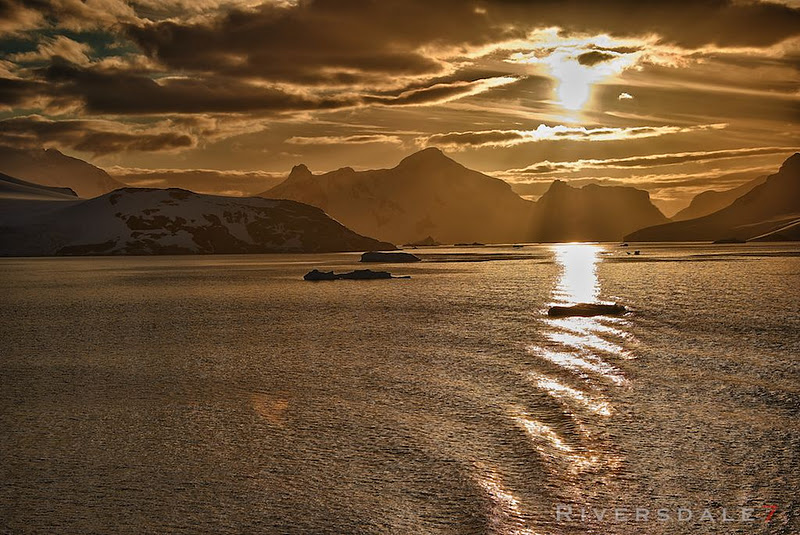
At the end of our visit around 20.00 some more clouds came up, hiding a part of the sun and produced dramatic scenery in the sky to say good bye to us. During Dinner we heaved anchor and sailed towards our next destination Cuverville Island.

Sunday, 15 January 2012

Again back through the Drake

Before enjoying something you have to work for it and before experiencing the beauty of Antarctica you have to suffer the Drake Passage.

After the clearance by the Argentinean authorities, we set sail from Ushuaia. After six hours in the calm waters of the Beagle Channel giving us a comfortable first half of the night we entered the rough seas of the Drake Passage.
There were waves up to 6 to 8 meters high though we only had wind about Beaufort 6 to 7.
The high swell was the relic of the heavy storm we encountered during our way north through the Drake Passage to Ushuaia two days ago. It takes two days for the sea to calm down after such a heavy storm. Some of our passengers, exhausted by the long voyage from all over the world to Ushuaia, suffered from seasickness. Others were on the outside decks, to observe the true friends of all seamen, the masters of the winds, the albatrosses accompanying our ship the whole day together with some Giant petrels and Cape petrels.
The whole day long we listened to lectures about things and subjects we are going to see during our stay in Antarctica like penguins, whales, seals, ice, geology and history in English, German and French. Westerly winds supported the ship to higher speed and we will reach our first landing at Half Moon Island in time tomorrow afternoon. The wind calmed down during the day and the waves smoothened thus most of us could enjoy the Welcome Dinner at the end of the day.

Saturday, 14 January 2012

Ushuaia once more!

Ushuaia, the southernmost town in the world (as they claim), always means one thing for our ship:
Turnaround time!
For the staff, this is the busiest day of each trip. All cabins have to be cleaned, the luggage has to be distributed, information on boards is replaced… and hundreds of other things are being taken care of.
One minute we wave goodbye to the passengers with whom we shared so many exciting moments during the last few days and the next moment we are already welcoming our new guests. As they arrive and get familiar with the vessel, we too start to get excited about the new trip that lies ahead of us.
How is the weather going to be this time? Will we see any whales? Will we encounter a lot of ice? Each voyage is different, each one unique. That is why Antarctica is such a special destination. And that is why even for the expedition members, some of us with 30,40, 50 or even more trips to the white continent, the fascination and expectation remains . We cannot wait to share our passion for the polar regions - once more!

Friday, 13 January 2012

Land in sight!!


Today we woke up to a deja vue. Wind and swell increased about 6 o’clock and during the breakfast we had a sea stage up to 7 in Beaufort scale.
At 9:30 we started our usual sea day education program. Manuel, Rudolf, Jean Louis and Uli gave us many interesting lectures in their fields of interest. After so many lectures and information what we have received during the trip, some of us have a feeling to be covered by knowledge as thick as average thickness of the Antarctic ice cover (almost 2 km). 
 At 13:27 land was spotted! Famous Cape Horn was in sight. Half an hour later we were cruising in front of that cape, hated by sailors. Many sailors lost their lives while trying to round it. We approached the Cape Horn from the west – the Pacific Ocean, and after we crossed its meridian, we were in the Atlantic Ocean.
After lunch our education program continued with Arnau lecturing about historical Fram expeditions. We also had glimpse of life at Svalbard presented by Calle who lives and studies in Longyerbyen/Svalbard. During the “Climate discussion” we explored issues around our own contributions to climate change, and how we could minimize our own impacts. Many of us didn’t realize how complicated and interrelated the issues are.
Captains farewell was a welcome change of pace, with cocktails in hand. The cocktails relaxed us for the upcoming auction, including the Hurtigruten flag, voyage chart and chef engineer’s jacket. All the money from the auction went to “Save the Albatross” program.
At night we’ll enter Beagle Channel, and tomorrow at 6 am, we will be in Ushuaia. As we turn our hands to pack our bags, we reluctantly acknowledge that this amazing journey to a fragile environment is coming to an end, whilst we continue to assess how we have been touched by the frozen continent.

Thursday, 12 January 2012

The drink of the day: Drake shake

Today many of our passengers had the chance to prove to themselves how good their sea legs were. A rough Drake greeted us in the early morning hours, and while taking our breakfast the waves were cleaning the windows of the dining room. This means their height was about 7 meters, because there were reaching deck 4. In other words, we were in a small storm, level 9 on the Beaufort scale. Luckily enough, the rough sea declined during the day and most of the ones who were invited to the bridge visits could attend.


During the day, and especially during afternoon, the sky cleared up many times, and thanks the persisting relatively strong winds, our loyal companions the petrels and the albatrosses showed us the way north. It was a perfect day for bird watching on the outer decks us you can see from the following pictures provided by our resident photographer Dom.

The day was good for reflecting on the experiences we all had had during out time in Antarctica. Was it possible that only a few days ago we departed from our familiar world and only yesterday in the late afternoon we were still struggling against the wind, waves and cold to reach one of the greatest landing sites we were privileged to visit in the South Shetland Islands and Antarctica? Here we are, heading north, hanging onto our feelings of Antarctica, and not realizing that we have left part of ourselves there, more convinced that we have taken something from there, instead of the opposite. Everyone of has to decide which applies to themselves?

Wednesday, 11 January 2012

When Deception meets Hanna

Overnight we crossed Bransfield Strait. The day’s activities started shortly before 8 o’clock. Tidily packed on the outside decks we watched our approach to Deception Island. The Island was known to sealers as early as 1820. Later on, at the beginning of 20th century, it’s safe harbor was used by whalers.

Everybody was eager to see MV Fram sailing into 11 km by 6 km submerged caldera of active volcano. The only way in is through the 200 m wide Neptunes Bellows. In the middle of the entrance, just 2.5 m below the water surface, lies a rock, so the only safe way in is just 80 m wide.
After half an hour steaming across caldera, time which was used by Uli to talk and talk on his favorite subject Geology. We were all amazed by his passion for rocks. We reached our landing destination - Telefon Bay. A smooth disembarkation saw the start 1.5 km walk around one of the volcano craters formed during 1969/1970 eruption. Our Spanish guests were invited to visit Spain Research Station Gabriel de Castilla. The Deception Island Beach Club also was open for new members. Although many hot springs are present in Deception Island, the water in the caldera is rather cold but … how often do you have a change to plunge in Antarctic water?
After lunch and short rest we found MV Fram staying at anchor in front of Hannah Point/Livingston Island. The weather was not favorable but Captain and Expedition Leader decided to give a try. It was worth it! The ride in PolarCirkle Boats, from the ship to the shore, was bumpy and really wet but the wildlife we found ashore was incredible – and comments about being cold and wet where replaced instantly with ooh’s and ahh’s and did you see that. We were in our own wildlife park, with all sorts of birds, including three species of penguins, both species of Antarctic flowering plants and seals. The biggest reward was of course Elephant Seals and Macaroni Penguins. The landing was a succinct summary cruise. Yes, that was our last landing in Antarctica. Some of us already thinking about coming back here in the future, but all we can do now is to prepare our self for Drake Passage.

Antarctic Sound, music between the ice

With the memories of the wonderful afternoon and sunset we experienced the day before still fresh in our minds we began our new day sailing in the Bransfield Strait toward the Antarctic Sound.

This time we have to fight the tabular icebergs on our way which were impeding our transit to Paulet Island. Yes, we have no less in mind than follow the footsteps of Nordenskjold Swedish Expedition of 1902 to the very core of the big drama which took place in this tiny island. In this water their ship sank and the party found shelter amongst the huge Adelie penguin rookery.
While we could become familiar by the lectures given by Arnau of this heroic adventure of survival at the turn of the century, the scenery evoked on us a well known feeling of respect and friendliness. Uli and Jean Louis made us acquaintance with the ice and snow.
So with this combination of history and the cold wonders of the water and ice, we experienced a great afternoon landing in the volcanic island of Paulet.
Right now our very talented crew is performing their show and you imagine, nobody would like to miss it. Being so, we have no other option than say good by and see you tomorrow. Another great day will begin………


Monday, 9 January 2012

What a beautiful day!

Our plans for the morning were different, but change is a part of Antarctic Expedition. We planed to sail through the 10 km long and narrow Lemaire Channel to reach the Ukrainian Research Station Vernadsky, located on the Argentine Islands. Well, that was the plan…..
The Lemaire Channel welcomed us with a wind speed of 20 knots and light sleet. As we progressed, we were stopedp by heavy ice conditions. It was impossible to go further south, so instead of landing at Vernadsky, we put our PolarCirkle Boats in the water in the middle of the Channel. Incredible ice cruising was the result. We found a Leopard Seal, a Weddell Seal and a Crabeater Seal resting on separate the ice floes, surrounded by plenty of amazing sea and glacier ice.
At the end of the operations the weather improved so much that we could see the top of double peaked Cape Renard, the Northern Guardian of the Lemaire Channel.
The afternoon saw us steaming between icebergs, as we made our way to the next destination - Paradise Harbour and Argentinean Station Almirante Brown. Paradise Harbour lived up to its name today. Sun shining and no wind at all, perfect conditions for landing. If we do not count the Gentoo Penguins nesting around the buildings, there are no personnel at the Base. Of course almost all of us had to climb the hill behind the Station. It is not too high a climb, but the recent falls of heavy snow hampered progress up the hill.

The view from the top was the best reward for the effort. The very clear air and beautifully shining Sun gave us an impression that all mountains around were within our touch. The way down the hill was much easier and way more fun. Sit on your backside and slide baby slide. After that we still had time to check on the small Gentoo rookery and were rewarded to find in some nests, little tiny chicks – some less than a day old – some where even fortunate to witness the hatching.

Sunday, 8 January 2012

We are in action....

Today our day started with a visit to Cuverville Island, located between the Antarctic continent and Ronge Island. From a distance we could smell our friends on the island, the gentoo penguins. Once there, we forgot about their personal perfume and were delighted by the bustling activity within their rookeries, and the accompanying cacophony of constant communication. An iceberg alley encircled the landing site transforming the approach to it, adding an additional highlight to the morning. Thousands of penguins were enjoying the beautiful morning light, going about their daily affairs, like stealing pebbles from their neighbors nest, and chasing skuas out of the rookery and so on.


After some hours of sailing through the scenic Errera Channel and Neumyer Channel we arrived at Jougla Point and Port Lockroy. The remnants of former splendid whales were laying on the beach to recreate a full skeleton of a humpback whale. Nearby nesting blue eyed cormorants added more life to the already hatched gentoo penguin chicks in the extensively extended colony. Ever watchful parents of both gentoos and cormorants were taking care with parental enthusiasm and dedication their chicks.


Port Lockroy and their friendly inhabitants – members of the Antarctic Heritage Trust - received us with great joy and showed us the well preserved details of the historic huts and surroundings. It is always a pleasure when both parties are pleased while meeting, and here this is the case. This time our contribution to the Heritage Trust only for a few days and in the form of a loan, was one of our two expedition leaders: Anja, she decided that time was ripe for a closer understanding of penguin behavior and the best way to do such, was spending some days amongst them at Port Lockroy. Here you can see her happy face while moving in. Good luck. Maybe we will see you in 10 days boss……. 

Saturday, 7 January 2012

Antarctica, We made it!

Here we are, officially in Antarctica after crossing the Antarctic Convergence and filled our normal daily life on board Fram with bridge visits, lectures, boots distribution and the most important: enjoying the atmosphere of this great southern ocean loaded with memories of heroic actions and dreams of wealth and glory. 
At lunchtime we encountered our first icebergs, telling us that we have come into the domain of the penguins and whales. At around 3 pm we saw our first islands, Nelson and Robert. After more than 40 hours of sailing we have succeeded in – recreating a time span of approximately 40 millions years, that’s when South America separated from Antarctica: we are now at the entrance to Antarctica, around the South Shetland Islands.
After lunch, the crucial moment arrived and we bravely attempted our first landing on Half Moon Island, under strong winds and heavy snowfall. Our faithful companions, the chinstrap penguins were eagerly awaiting to greet us. While ashore, the conditions became better and what was a stunning inhospitable landscape, transformed with sunshine, into a picture of indescribable beauty. Here, you can judge for yourself: Pictures and images from different moments a few minutes apart.

We are reminded of that popular song by Phil Collins “Another Day in Paradise”.

Friday, 6 January 2012

Drake Passage

Today we have been sharing the habitat of the Drake Passage with magnificent Albatrosses. The sun has been friendly to us and between lectures we could go outside and take advantage of the fine weather. Our resident photographer Dom brought some of our feathery companions within touching distance with his camera.


For all of you who have been here before, and those yet to visit these latitudes, our chart on the bridge gave us the position where we were at midday. As you can see, no matter in which direction we looked, we were surrounded by water up tol 3500 m deep. This body of water is home to one of the biggest ocean currents on earth, to be more precise it holds 137 “sverdrups” or the equivalent of all the fresh water rivers of the planet in one single stream multiplied by 137. Can you imagine having to pay that water bill?
Meanwhile we continued heading south and hope that the weather and Mr. Drake behaves like a gentleman and make merits for the title he holds. At one point during this night we are going to cross the Antarctic Convergence and officially enter the Southern Ocean and Antarctica. We are keen to fell the bump while crossing the Convergence tonight, and with that we wish you a Good night.

Wednesday, 4 January 2012

Turn around day and a cause for celebration

Its Wednesday and its Ushuaia, this means only one thing, turn around day- we say fond farewell to our friends that have travelled with us to the Islas Malvinas, South Georgia, South Orkney and to the tip of the Antarctic Peninsula. We wish you all a safe journey back home and look forward to seeing you again one day!

Our new friends are arriving, curious of what is going to lie ahead of them, anxious to get going. The start of the journey is in Ushuaia, the southernmost city of the world, approximately 3000km south of Buenos Aires. It started as a colony of prisoners and today is a bustling vibrant city.

For our own reasons, today is a special day to celebrate. Our humble blog started 1000 entries ago. If you have been following our blog, do you remember how it all started? The first blog entries were done by Steffen and Karin, and how it has grown over the years into the detailed and fancy creation it is today.

The expedition team takes great pride in creating different entries each day, some may say somewhat competitively. But today it is blog entry ONE THOUSAND! And I actually wonder how many beautiful pictures were published in the blog as well during 1000 entries… over 3000 or more? What a great book that actually would be make if we just decided to print it!

Today, both Expedition Leaders of Fram (Anja &Karin) would like to say a tremendous THANK YOU to the staff that write the blog after their working hours, for all the sweat that you put into it, the thoughts, the pictures and the creativity! To you our dear readers, thank YOU for following us no matter where we are, be it in the North or South or Ports in between. We look forward to regaling you with our adventures over the next 1000 entries.