Sunday, 12 February 2012

Our Last Landing :^(


Brown Bluff
Photo © Andrew Wenzel

The weather was a mixed bag this morning.  Nothing bad but it started off sunny then became solid overcast which was followed shortly after by foggy, then sunny/cloudy again.  And all of that was before 10:00.  
Today was our day on the north east side of the Antarctic Peninsula in the Weddell Sea.

It’s a bit of a different world on this side of the peninsula.  This is the land of colossal icebergs.  Huge tabular icebergs break off ice shelves further south and drift ponderously northwards.  They are quite special to see and very different from ice bergs that have calved from a glacier.  Some of the icebergs we see over here are bigger than some of the islands on which we have landed.
At around 10:00 we were in Antarctic Sound. Very often large tabular icebergs collect in this area and today was no different.  We had made very good progress through the night and were ahead of schedule.  We would be able to make our landing at Brown Bluff a full two hours ahead of schedule!
View of Glacier at Brown Bluff
Photo © Andrew Wenzel
As we approached Brown Bluff it was easy to see how it got its name.  Huge brown cliffs stretched high above the landing site.  Andy and Torbjørn set red flags out to mark a trail up a steep moraine slope.  It was a bit of struggle to climb up the very loose moraine but the view at the top was worth it! 
Far below we could see the Gentoo and Adelie Penguin colonies.  A wall of brash ice and growlers lined the dark cobble-stoned beach from one end to the other.  There were approximately a dozen male Antarctic Fur Seals about 70 metres from the landing site.  Once they got used to our presence they quit growling at us, relaxed, lay down and continued their afternoon snooze.  
Brown Bluff
Photo © Andrew Wenzel
Quite close to landing site were several pairs of Kelp gulls with their chicks.  The chicks had shed their down and a few of them were already flying.
Throughout the landing a pair of Leopard 
Seals cruised up and down the beach looking for penguins to eat.  We saw at least two separate kills.  One of the Seals seemed to be toying with the penguins.  We saw the seal release a penguin and then go after it again.  We also witnessed a couple of penguins hobble onto the beach with severe injuries.  
Large tabular iceberg Fridjof Sound
Photo © Andrew Wenzel
It is a good time of year for Leopard Seals. The chicks are now venturing into the ocean for the first time.  Young inexperienced birds provide an easier meal for a ravenous seal.
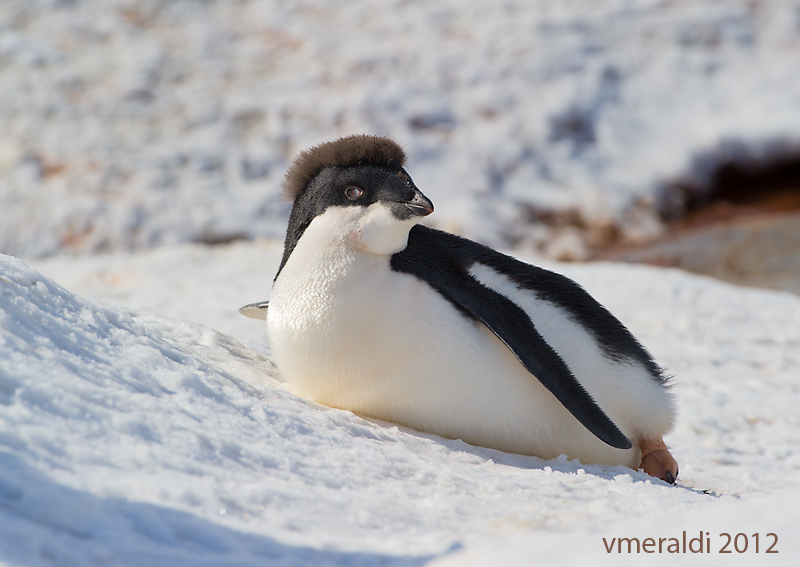
We could see young Adelie chicks on some of the icebergs close to shore.  Some of them still sported tufts of fluffy down on their heads.
Shortly after 16:00 we were all back on the ship again.  The decision was made to voyage through picturesque Fridjøf  Sound and further into the Weddell Sea for more opportunities of large tabular iceberg watching.
Brown Bluff is a very special place.  It is one of the more beautiful landing sites in Antarctica.  It will remain extra special for all of us on this trip as it was, for many of us, our last landing in Antarctica.

Port Lockroy and Jougla Point


Whale bones at Jougla Point
photo copywright Lisa Anderson
We anchored at 0830, the sky was 100% overcast and gusty winds were blowing from Wiencke Island and Goudier Island toward the Fram. Our first landing was at Jougla Point on Wiencke Island, here the Expedition Staff had set out trails that enabled us to visit the Gentoo penguin colony. Skua’s were aggressively working to single out penguin chicks for their next meal. Blue-eyed shags and snowy sheath-bills were also sighted. The scattered whale bones on Jougla Point document that this area was used by whalers. Some of the whale bones have been “re-assembled” to look like a complete whale skeleton, but our guides informed us that the skeleton was assembled using bones from several different species of whales. A short ride in our polarCirkel boats took us to Port Lockroy on the very small Goudier Island.

Port Lockroy
photo copyright Lisa Anderson
Port Lockroy was discovered and named in 1904 by Jean Baptiste Charcot during the first French Antarctic expedition. Though the name is French the present human occupants are British. Bransfield House is the main building and it is currently maintained by the United Kingdom Antarctic Heritage Trust (UKAHT). Originally the building was Base “A” of the British World War II “Operation Tabarin” to observe wartime enemy activities around the Peninsula. After the war the base was used as a scientific station by the British Antarctic Survey. In 1962 the base was closed, but in 1995 it was designated an Antarctic Historic Site and Monument. This designation initiated a restoration project in 1996 to preserve the building and its contents as closely as possible to their 1962 condition. Since 2006 the UKAHT has maintained the base and operated the post office, museum and gift shop. The UKAHT is a non-profit organization and the proceeds from the items sold at the gift shop are used by the UKAHT to preserve and restore historic Antarctic buildings. We did our part to help this good cause as we purchased clothing plus many maps and books at the gift shop.
Relic sledges at Port Lockroy
photo copyright Lisa Anderson

Our afternoon transit of Neumeyer Channel to Wilhelmina Bay was overcast with some fog and precipitation that ranged from snow to sleet to rain, with occasional clear parches. Once in Wilhelmina Bay the visibility improved and the bay lived up to its reputation as an excellent whale watching area. As Fram motored along at reduced speed we sighted several humpback and minke whales.

As we continued northward, the day closed in the Panorama Lounge with a lot of laughs as our ever versatile crew entertained us with songs, dances and skits.
Evening at Port Lockroy
photo copyright Lisa Anderson

Saturday, 11 February 2012

Against all odds: the Fram conquered the ice


Late last night the Fram sailed through a dense one year pack ice field. It was impressive! She smoothly made her way through the ice, which would close immediately after her passage. To add to the atmosphere, it started snowing, we felt like explorers onboard an icebreaker on our way to an extremely remote place in the middle of the winter. This ice crossing allowed us to reach Petermann Island for our morning landing.

This Island was discovered by the german sealer Eduard Dallamann during his 1873-1874 expedition, he named it for the german geographer August Petermann. The island is also known for having sheltered the french explorer Jean-Baptiste Charcot and his crew after their ship, the Pourquoi pas? ran aground not far from there. 
Photo © Andy Wenzel

Blue-eyed Shag
We were welcomed by a “mini” blizzard; snow and wind blowing from the north made it almost impossible to see further than a few meters away. But very quickly the time changed, the clouds continued passing but gave way to a sunny day, creating nice shadows and nuances on the landscape. 

Regarding wildlife, this island offers a great variety of species. We saw Gentoo and Adelie Penguins, Blue-eyed Shags, Skuas, Terns, Giant Petrels and Kelp Gulls. This is the southern most Gentoo Penguin breeding colony, and ironically, chicks here (65°10’S) were more advanced than on Cuverville Island (64°41’S). 

Adelie Penguin chick

Several Adelie Penguin chicks had already fledged and were ready to start an ocean life. Iceberg alley is on the south-west shore of the island, we had the chance to see one iceberg breaking up and turning in the search for a new floating equilibrium. 
Weddell Seal

 During lunch time we sailed through the very narrow Lemaire Channel. This 11 km long and 1.6 km wide passage was also discovered during the 1873-1874 german expedition, but it was named by Adrien de Gerlache during the belgian expedition in 1898 for the Congo explorer Charles Lemaire. 


Leopard Seal - Photo © Lisa Anderson
The crossing of this channel by good weather is one of the highlights of an Antarctic Trip. We confirmed that with a Polar Cirkel boat cruising after lunch. The ice floes around the vessel had extremely beautiful shapes and colors, and on many of them we could find Weddell Seals, Crabeater Seals and Leopard Seals resting. This was, once again, a wonderful day down south.


Crabeater Seal

Friday, 10 February 2012

Too Much Of A Good Thing


Crabeater Seals near the Antarctic Circle
Photo © Andrew Wenzel
Too much of a good thing.  It seems ironic that the very thing we were hoping to see prevented us from reaching one of our goals.  Ice.  We left home with visions of icebergs, glaciers and pack ice dancing in our heads.  Antarctica means ice and we wanted to see it. And today we saw ice.  Lots and lots of ice.  As we approached the Antarctic Circle we followed the edge of pack ice left over from last year.  The Captain hoped to find a safe avenue to enter Crystal Sound which would lead us into The Gullet and then on into Marguerite Bay.  But the ice was 5/10 and continued beyond the range of our radar.  At the same time we were experiencing winds of 20m/s which was causing the ice to move quickly. The thickness of sea ice is rated on a scale of 10, with 10/10 being 100% ice and 5/10 being 50% open water, 50% sea ice.    Fram can go through about .50 metres of new open sea ice but if that ice closes it might be a different story.  Years ago I was on a smaller ship stuck in sea ice that was 10/10 for as far as you could see.  It was a frighteningly beautiful sight.  One that I would rather not see again.  As we have repeated probably 100 times on this blog, the weather and the ice dictate where we can go and what we can do.
But we are "glass half full" kind of people.  The ice was beautiful. There were hundreds of Crabeater Seals scattered about on ice floes and here and there was the odd Leopard Seal.  We even passed by two logging (resting at the surface) Humpback Whales and then at 10:06 the ship’s horn sounded as we crossed the Antarctic Circle! We were having a spectacular morning!
Soon after crossing the Circle, the Captain brought Fram about and we began to head our way north.  Our plan was to make for the Fish Islands and attempt a landing later in the day.
King Neptune dumping ice water on Torbjørn
Photo © Lisa Andersen
En route we had a surprise visit from King Neptune on deck seven.  King Neptune was collecting payment for us having crossed the Antarctic Circle.  Anyone willing to pay the sacrifice had icy water poured down the back of their neck.  The consolation was a shot of rum right after!  Surprisingly there was a lineup of eager (crazy!) people anxious to have ice water dumped on them.  Or was it the Rum they were after?  The last person in line was Torbjørn who had the entire bucket dumped on his head!  Actually he wasn’t in line.  He got dragged over! 
Adelie Penguins, Fish Islands
Photo © Andrew Wenzel
Fish Islands
Photo © Andrew Wenzel
At 17:30 we were ready to make a landing at the Fish Islands.  It was a really nice, mild evening.  The island we landed on couldn’t have been much more than 100 metres long but it was the site of a boisterous Adelie Penguin colony. 
The chicks were quite large.  Many of them had shed their down.  There were also many adults molting. 
Just before the landing was over the tide had changed and the ice began to quickly move in.  The few remaining people on shore were hustled back to the landing site where we beat a hasty retreat back to Fram.
Now it is 23:20 and as I look out the window just before posting this blog entry, the ice is approaching 8/10.  I wonder what the night and morning have in store for us?  Stay tuned.

Thursday, 9 February 2012

Neko Harbor: a class of its own and Cuverville Island


At Neko Harbor the view in every direction provides a spectacular scene of mountains and ice. Today was especially memorable as the sun broke through the clouds and we could clearly see the ridgeline of alpine glaciers that descend from the mainland of the Antarctic Peninsula and calve into the sea. The short stretch of water between the Fram and our landing location was cluttered with rapidly moving small to medium sized pieces of recently calved icebergs.


For most of us our Polar Circle boat ride to shore was uneventful, but 2 or 3 boatfuls of us were fortunate to have a pod of Orcas (Killer Whales) pass quite near us. The large males have dorsal fins up to 1 meter (3 feet) high and these can be easily seen when they breach the waters surface to breathe. We were also fortunate to have several Minke whales circle the Fram and our Polarcircle boats.


The Neko Harbor penguin colony and the much larger Cuverville penguin colony that we visited later this afternoon are both Gentoo Penguin colonies. At both colonies there were a few large chicks but at both sites there were many recently hatched chicks. It is questionable if these chicks born near the end of the Antarctic summer season will survive. Two factors work against their survival, their down coat does not insulate them or shed water when rain or sleet soaks them. The second factor is that juvenile penguins must fully molt their down and grow their shiny specialized feathers, before the sea surface freezes and they have to head to open water at the ice edge to feed.

Our perfect weather day closed with the Fram crew and the Expedition staff serving as, quite amateur, models and strutting around the Observation Lounge wearing some of the colorful and fashionable items that are available in our ships store.


Wednesday, 8 February 2012

The unforgettable Deception


Deception Island is a ring-shaped island laying nearly 10 miles south of Livingston Island, in the South Shetland Islands. It has a central landlocked harbor, a drowned breached crater called Port Foster. This is one of the safest natural harbors in the world. To attain this safe shelter, ships have to navigate through a narrow entrance known as the Neptune Bellows. 

This beautiful and sunny morning the keen hikers onboard started an early hike to Baily Head, a rocky headland exposed to the Bransfield Strait out on the south east coast of Deception Island that is home to some 100’000 Chinstrap Penguin breeding pairs. The rest of us stayed at Whalers Bay and visited the ruins of the Norwegian Whaling Company Hector, which operated from 1912 to 1931 and worked chiefly in the waters of the South Shetland Islands. After the whaling station was abandoned due to a fall in the whale oil price, the British established the Base B from 1943 to 1944 as part of the Tabarin operation. This was later transformed into a scientific facility of the British Antarctic Survey, but it had to be evacuated after a mud slide following a volcanic eruption in 1969 which severely damaged the buildings.
The bravest of us even had a little Antarctic swim!! Due to the volcanic activity, water is less cold here than anywhere else in Antarctica, making this the perfect place to achieve this challenge.

After lunch we arrived at the Argentinian Station Primero de Mayo, which was the starting point to our afternoon hike, this time to another Chinstrap Colony on the northern shore of Deception Island, facing the Antarctic Peninsula. This second hike was less strenuous than the first one but still had some steep slopes. The reward was fabulous: great panoramas, the sighting of the first icebergs, and a splendid view of the Penguin Colony. 


We are now heading south. We wish to see many more icebergs and to have good weather! 

Tuesday, 7 February 2012

Medivac!


Photo © Andrew Wenzel

We have written often about wilderness adventure.  About one of the last great frontiers on earth. About the long arduous journey one takes to get to Antarctica.  We have gone to great lengths to get far, far away, to cast off the trappings of city life and immerse ourselves in a remote and wild place. Getting this far away means we are far removed from the safety and care that our cozy modern societies have to offer us at home.  If you get sick or injured, the nearest full facility hospital may be days away. 
Russian Base Bellingshausen, Orthodox church in the background.
Photo © Andrew Wenzel
Yesterday evening one of our guests, a senior gentleman, slipped and fell awkwardly while on shore resulting in a rather severe injury to his hip.  We have an excellent Doctor and nurse on board Fram that are available 24 hours a day, 365 days/week plus a well equipped hospital.  But many injuries and illnesses require special attention and this was one of those injuries.  Fortunately we were at Halfmoon Island when the accident occurred.  Fortunate because we were within a few of hours sailing to the Chilean Base Eduardo Frei on King George Island where there is a landing strip from where someone can be medi-vacced. 
Eduardo Frei, Chilean Base and Bellingshausen,
Russian Base, King George Island.
Photo © Andrew Wenzel
A series of radio and phone calls were made to Eduardo Frei and the medical centre in Punta Arenas.  Very soon a flight from Punta Arenas to King George Island was arranged for the following morning and Fram was on her way to the Chilean Base.  It was remarkable really how efficiently and quickly everything was arranged.  Really remarkable when you consider that we are on a ship in Antarctica.
the last we heard the gentleman was doing well in the hospital in Punta Arenas.
But then what?  Obviously we had made a big change in our itinerary.  Well, just as smoothly, arrangements were made for us to visit the chuilean Base and the Russian base, Bellingshausen in the morning while we waited for the flight to arrive.
Our nurse, Cecilia and Marilyn from reception at
The Great Wall, Chinese Base, King George Island
Photo © Andrew Wenzel
It was beautiful morning.  We got to walk around both bases and even had time to hike over to the Chinese Base “The Great Wall.”
In the afternoon we visited a Gentoo Penguin colony on Ardley Island which lay about 500 metres off shore from the bases we had visited in the morning.
We had fair weather.  It was partially sunny with a cool breeze.  The chicks were all off the nest and roaming all over the landing site.  They are now at the age when they are the most fun.  There is a stage Gentoo chicks go through when they are very inquisitive and often will approach people.  On numerous occasions I saw curious chicks pecking at people’s clothing or boots while the object of the penguin’s attention stood in rapt wonder over this unexpected intimate encounter with a wild animal. Sometimes one chick would suddenly run amok, flapping its wings furiously and squawking shrilly.  These frantic antics never failed to make me laugh out loud. 
Photo © Andrew Wenzel
Yesterday we had feeding Humpback Whales right alongside the ship.  We saw our first penguins and hiked to a stunning viewpoint overlooking the sea and glaciated mountains.  Today we had penguins pulling on our clothing.  Imagine that!  


You can’t have these amazing encounters whilst safely ensconced in a comfy armchair at home.

Monday, 6 February 2012

Smooth Sailing

Feeding Humpback Whale in Nelson Strait
Photo copyright Lisa Andersen
SMOOTH SAILING; was the phrase that characterized the southern half of transit across the Drake Passage and our approach to our Half-Moon Island. Offshore the FRAM was accompanied by squadrons of Cape Petrels and those of us on deck sighted our first Antarctic iceberg at 1000 and only a few minutes later the iceberg was framed by a rainbow.

Camara Base, Half moon Island
Photo copyright Lisa Andersen
In preparation for our landings in Antarctica we all attended the IAATO briefings. These briefings are formatted by the International Association of Antarctic Tour Operators and attendance is required for all of us who intend to go ashore. We learned the reasons that our backpacks are vacuumed before out first landing and why we need to step in the disinfectant when we return to the ship.

Camara Base personnel
Photo copyright Lisa Andersen
The lectures also covered the procedure for checking out and boarding the Polarcirkle Boats. Importantly we also learned to respect the penguin’s privacy. On land we need to stay at least 5 meters or 15 feet away from the penguins. As we left the IAATO lecture the news came over the speaker system that whales had been sighted ahead. For over half an hour we were entertained by three humpbacks feasting on a large swarm of krill.


Left to right:  Our Hotel Manager KjelL Karlsen, our
Chief Purser Line Overgaard & Captain Rune Andreassen
Photo copyright Lisa Andersen
Our landing a Half-Moon Island was a bit challenging as the surf rolled back and forth in the swash zone. But once ashore we headed off in several directions, some of us went “over the hill” to see the Macaroni penguin that appears to happily live among 100’s or 1000’s of Chinstrap penguins. Others of us visited the Argentine Camara Station where the personnel welcomed us with open arms. From Camara Station some of us hiked across the beach ridge to climb the large hill that provided a wonderful overview of the Station, Half-Moon Island, Livingston Island and the FRAM at anchor in the bay below. After this our first days outing in Antarctica we returned to the ship where we all enjoyed a delicious buffet dinner.

Sunday, 5 February 2012

Sir Francis and the Drake

Photo copyright Lisa Anderson

Photo copyright Lisa Anderson

On 15 November 1577, a fleet of 5 ships sailed from Plymouth. At it’s command was Sir Francis Drake, who had the mission of plundering unfortified Spanish towns on the Pacific Coast of Chile and Peru. After reaching Puerto San Julian in Argentina, he decided to reduce his fleet to 3 ships and headed to the Magellan Strait. 

As they emerged in the Pacific a gale scattered the ships, one was lost, one managed to return into the Magellan Strait, and the Golden Hind was driven far to the west and south. He finally reached Cape Horn and wrote “...there is no main island to be seen to the southwards but that the Atlantic Ocean and the South Sea meet”. 

The open sea south of Cape Horn was called Drake Passage even though Drake himself never traversed it.  
A storm with winds of up to 25m/s was announced, it was to touch us as soon as we left the Beagle Channel region and headed to the open seas. We feared we would have a quite “shaky” Drake, just as the one that Sir Francis Drake experienced, but it wasn’t that bad! 

We could enjoy a nice and sunny day onboard, with lectures and a birdwatching session on deck 7. 


Photo copyright Lisa Anderson
Several Wandering Albatrosses were planning in the strong winds all around the ship, coming close enough for us to distinguish the marked coloration differences between adult and young birds. 


Adults have all white bodies with the exception of the wing tips, which are dark colored, almost black. Young birds are more colorful, they have some creamy patches on the head and fully dark wings, only the back of the birds is white. 

Some Black Browed Albatrosses and Giant Petrels were also enjoying the wind currents, and we even saw a White Chinned Petrel, a bird that is not as common as the mentioned before.


Saturday, 4 February 2012

Where Is Everyone From?

Photo copyright Lisa Anderson
An Expedition Cruise on Fram to Antarctica is not just about going to Antarctica. It is also an opportunity to meet like-minded people from all over the world. On this voyage alone, there are people from 24 different countries and every single one of them share common interests. Where else can you go, what else can you do where you will encounter a similar situation? Where can you meet so many people from such diverse cultures that are assembled for the same reasons? On top of that, everyone here is happy. Everyone is in a great mood. Everyone is open for new experiences. Of course they are. Everyone is on vacation. Many people here are on a trip of a lifetime. Some people have been saving for, or perhaps dreaming about this trip for years.

To all of you on board Fram right now, seize the opportunity to get to know your fellow ship mates. Mix it up at meal times. Dare to sit with new people. Don’t be shy! Try to experience some of the different cultural opportunities right on board the ship. It will definitely enhance your experience with us in Antarctica. And who knows, maybe you’ll make new friends from an exotic location that you always wanted to visit ( if you know what I mean ;^) )!

Photo copyright Lisa Anderson
Where is everyone from? AUSTRIA, AUSTRALIA, JAPAN, CHILE, CHINA, DENMARK, FRANCE, GERMANY, GREAT BRITAIN, BELGIUM, ITALY, INDIA, LUXEMBOURG, NETHERLANDS, NORWAY, SWEDEN, SWITZERLAND, UNITED STATES, CANADA, POLAND, MEXICO, PANAMA, PHILIPPINES AND INDONESIA.

Once everyone was on board and all of the luggage had arrived we cast off our lines (at 19:00) and headed east in the scenic Beagle Channel on our way to the South Atlantic.

Photo copyright Lisa Anderson
At 20:30 we all took part in a mandatory safety drill. Almost immediately after the drill we were invited to the Observation Lounge where the Captain gave a short welcome speech and introduced us to the officers and some of the key members of the ship including our Expedition Leader Karin Strand. Karin then introduced everyone to the Expedition Team.

We went to bed thinking about the long hard journey we had all undergone to get to the ship here at the bottom of the world. We wondered what marvels and adventures the coming days would reveal. Day by day, here on the blog we will unveil our experiences for you. Stay tuned. Tomorrow is the infamous Drake.


Thursday, 2 February 2012

Neptune's gift


Oh yes! We got what we wanted! According to the Beaufort Scale, a value of 10 represents a Storm, winds of up to 28m/s were producing 10m high waves. The Fram proved that she can manage stormy weather pretty nicely. Although she is so good in rough waters, we still had to be very cautious when moving around the ship, we were advised to use the handrails as much as possible and some lectures had to be cancelled due to the impressive rocking of the Fram. Having lunch was also a fun challenge! A pile of plates ended up on the ground and we had to hold on to our glasses so we wouldn't lose them!


Once we approached the safety of the South American Continent things went back to normal. The Captain offered a farewell cocktail, a last opportunity to gather everyone in the panorama lounge and share our memories and have a toast to our very successful trip. Right after the cocktail we had the charity auction of the Master Chart and the Flag that flew at the stern of the Fram throughout our voyage. Not all of us could eat during the storm so when the four course dinner was served in the restaurant we were hungry. The chefs have treated us very well this trip, luckily we had the chance to burn some calories on all those landings and hikes. 12 days have we been out at sea, 13 landings, 7  hikes, spectacular animal life and today the storm. This trip has been a great success!!