Monday, 27 August 2012

Charismatic Megafauna


It has been a brisk pace.  We have already seen and done a lot.  It seems as if every day is full.  Our list of charismatic mega fauna is impressive.  Let’s pause for review.  In four long days (Or is it one continuous day? After all, the sun never sets.) we have seen the magnificent Blue Whale, Humpback and Beluga Whales, Walrus, Harbour and Bearded Seals, herds of Reindeer and while we don’t suggest that the diminutive Arctic Fox can be described as mega fauna, we have seen many foxes.  We have also seen thousands of sea birds including Puffins and Ivory Gulls.

There is one animal that we are missing.  I don’t dare mention its name lest I be the jinx.  It is large.  It is white and it is the apex land predator in the Arctic.  It can definitely be classed as charismatic quadripedal mega fauna.  

Optimism is high and we have plenty of time, but you can see people beginning to walk around with crossed fingers.
This morning we had time for a leisurely breakfast as our first landing was scheduled for 10:30.  It was a treat to sleep in if so inclined.  

We landed at Kapp Lee on Edgeøya. It is well known as a favoured Walrus haul-out site.  There were no toothy pinnipeds on the beach, but soon a group of three emerged from the sea and seemed curious about the group of people ooohing and aaahing on the water’s edge. The walrus came within15 metres and then leisurely made their way to the far end of the bay.

Meanwhile a group of hikers set off to climb to the very impressive cliffs tops of Kapp Lee.  The Expedition Team set out flags from the landing site and cautioned everyone of the necessity to stay on the marked trail.  There was a very real danger of getting stuck in deep, sucking mud and to not be able to extricate oneself. Despite the warnings, people wandered off the trail.  More than one person found themselves needing assistance  to free themselves from a clay quagmire.

By 14:00 everyone was back on Fram.  We scheduled several lectures for the afternoon.  There was ample time to attend a lecture or visit the gym, or luxuriate in the sauna, or jacuzzi.
At 21:45 we were all invited to the Observation Lounge where some of the hip’s officers and the Expedition Team modeled apparel from the gift shop.  


Sunday, 26 August 2012

Walking with Walrus


We must have done something right - another bright sunny morning. This morning we take a leap into the rather recent history of Svalbard by going to Kinnvika at the western coast of Nordaustlandet.

Imagine a time when the whole scientific world agrees upon the necessity of preserving vast areas of this planet, of spending big money on something that has no immediate output like oil or gold or rare earth minerals. The yield was knowledge, understanding, protection. What seems like an impossible thing to happen nowadays was clearly the issue in the year 1957 when the first International Polar Year was held. Driven by the understanding that some of the key functions that control Earth's climate are hidden in the Arctic and Antarctic huge efforts were made toward a better grasp on these matters. And so they build the biggest station in the Arctic, with 11 buildings, a balloon shed and even a sauna. All this is situated in the vast beauty of the plains of Nordaustlandet, second largest island in the Svalbard archipelago. So a more than beautiful morning walk/hike builds the chilly overture of a day that turns out to be the longest of the trip.

A few hours later we sail by a famous rock cliff, Alkefjellet, a 100m sheer basalt cliff, the structure of which gives perfect shelter to a multitude of seabirds. The most abundant "tenant" in this natural apartment building, however, the Brunich's Guillemot has left already, leaving the space for ten thousands of Kittywakes and Glaucous gulls.

The skies are getting grey as we pull deeper into the Strait of Hinlopen, clouds are rolling low, promising rain. But the light! Photographers are awed by the spectacular contrasts between ice, brownish mountains and the black volcanic rocks that are pretty common here.
Winds are picking up, too, but fortunately our next landing site offers a little shelter.

Torellneset, a gravel spit that extends a few hundred meters into the strait and is a welcome haul-out for walruses. And indeed, already from the distance we can spot quite a few. And here is the difference to places like Moffen - now we can walk up to these strange creatures, be on the same piece of ground. Everybody is excited enough to totally ignore the few unavoidable splashes in the boat, and with great care we approach until we are a solid 35 meters away. It's the time to watch them struggling with the length of their tusks, smell their putrid odour, listen to their weird sounds. And take millions of pictures, of course.
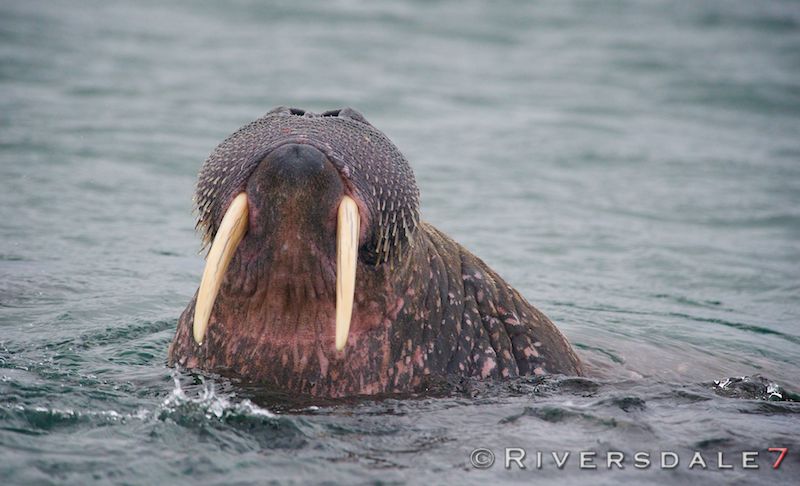
Suddenly movement in the water not far from us: Another group of walruses has decided to observe the observers. And as we assemble cautiously close to the beach we learn how curious these heavy aliens are: One by one they pop their heads out of the water to look at us. Every now and then they even dare to come ashore to get a better glimpse. Who's the attraction now? Them or us?

For quite a while they stay with us, follow us even as we walk along the shoreline. It's like having an escort from a different planet. What an encounter!!
As if the day wasn't long and beautiful enough we reach Bråsvellbreen at night, the longest glacier front in Svalbard, 192 kilometres of sheer ice. The evening light is something between eerie and charming, a perfect end for a perfect day.


Saturday, 25 August 2012

Serenity Valley


It is now day three of our Arctic escapades.  The scenery in Liefdefjorden surpasses our expectations.   Glaciers tumble down to the ocean on three sides of the ship.  Ragged mountains in sombre tones clutch at the glacial ice as it struggles to flow to the sea.  Fram is surrounded by heavy brash ice  that has calved off the front of Monaco Glacier.  The wind is less than 5 knots and variable.  Everywhere you look lies a postcard in waiting. 
Our plan this morning was to sortie in the Polar Cirkel boats and cruise through the brash ice.  At first it was heavy going as the ice was thickest at the ship.  It took about ten minutes to arrive near the front of Monaco Glacier.  The lucky people in the first two boats were graced with a pod of Beluga Whales.  We could see two calves sticking close by to their mothers in a group of approximately ten whales.   The whales seemed to be feeding right at the base of the glacier.  Monaco was calving a lot today.  Large blocks of ice landed perilously close to the whales.    The Belugas continued their way west along the glacier front where Polar Cirkel boats didn’t dare to go. 

We continued east along the glacier front encountering hundreds of Glaucous Gulls, Kittiwakes and Fulmars.  Parasitic Jeagers (Arctic Skuas) patrolled the sky looking for unwary seabirds making a catch of fish.  As soon as they spotted a Gull with a fresh fish, a chase would ensue with the result usually being that the gull dropped their meal and the Jaeger would catch its breakfast in mid air.

In the afternoon we landed at Mushamna.  There is a beautiful hunter’s cabin there.  It is possible to over winter as the cabin is in very good condition.  Each year there is a different tenant as qualified people need to apply to the Governor of Svalbard.  Tenancy is for one year only with a possibility to extend for a year, however Mushamna has been empty for the past three years.
It is very easy terrain in which to walk around.  We were free to explore the area around the cabin and to go much further afield.  The Expedition Team was, as usual, keeping a watchful eye out for Polar Bears.
There was also the opportunity to go on a two and a half hour hike.  The hike wound through a gorgeous valley with steep mountains rising abruptly on three sides.  Inside the valley you couldn’t hear a sound.  There wasn’t any wind.  No birds calling.  No engine noise from the ship or Polar Cirkel boats.  None of the noise associated with the trappings of a modern society. It was  truly serene. 


The last of the hikers returned to the ship at approximately 20:15.  Soon after Fram was on her way to Moffen Island where we hoped to see Walrus.    At about 22:30 we crossed N80˚ and could plainly see a group of Walrus huddled together just up from the beach.  Fram stood about three hundred metres off shore where we had excellent views of these unique marine mammals.

Friday, 24 August 2012

Everything's Ny


Changes don't take long in the High Latitudes, a mere two weeks can make a big difference: Instead of a permanent impression of lunchtime we have an Arctic morning now, the sun is so much lower already, the winds are picking up more readily, and the mountain tops were sprinkled with fresh snow as we left Longyearbyen. But as we enter Kongsfjord, the King's Bay, it's one layer less to put on instead of more: The skies have turned blue over night, the contrasts are stark on the mountains around Ny = New Ålesund, the northernmost civilian settlement on the planet. At nearly 79° North lies the stage for many different exciting stories - from the early and quite unsuccessful years of coal mining to the ridiculously overconfident ventures of Ernest Mansfield who claimed "Islands of pure marble" and convinced the financial elite in England to invest in an enterprise the charisma of which was only beaten by the scope of its failure. All that remains today is the quarry and the houses of Ny London, opposite Ny Ålesund.

We spot them from the pier, as we set off to a guided tour through this remarkable place, which served as the departure point for the most spectacular expeditions in the northern hemisphere - the quest for the North Pole by airship. Imagine a balloon, or better a "dirigibile" (a steerable balloon, zeppelin-style) the size of our FRAM attached to a tall mast in the middle of Arctic nowhere. Manned with a most unlikely group consisting of Umberto Nobile, Italian engineer and builder of the airship, Lincoln Ellsworth, American investor, and - Roald Amundsen, Norwegian superhero, previous victor of the race to the South Pole and charismatic explorer, the airship rose and reached the Pole in no time. Boring story, if it weren't for the aftermath, when Nobile, spurned by Amundsen's constant unmindfulness towards his colleague and the pressure from neofascist Italy, built his second airship, got lost in the attempt of reaching the Pole, and so triggered the biggest rescue operation in Polar History, during which Amundsen died.

All this is told in this amazing place, and there's even time after the tour to stroll and - enjoy the sun.
Just after casting the lines and making out of the Fjord a Blue Whale is sighted!!! This is one chance in a lifetime to see the biggest animal that ever lived on this beautiful planet, so the decks are crowded with happy people, wielding binoculars and cameras.

A few hours later we enter Magdalenafjorden, named after the biblical Maria Magdalena. Still no clouds, so get ready for the big hike to Gullybreen, a picturesque glacier round the corner of Gravneset, death stead of many a whale hunter in the 17th and 18th century. A large group assembles to tackle the uneven grounds across moraines and ice age beaches, and in a medium brisk pace we not only make it to the end of Gullybukta, but also even onto the moraine flank of the glacier itself, so we are offered a real close-up of the blue and white glacier, a tremendous sight!
Every now and then, a bearded seal pops its curious head out of the cold waters to have a better look at us - it is not very often it gets a visitor here…

After about three hours we return to the landing site, where meanwhile the brash ice has forced the boats to retreat to a different spot. So, no swimming here, not today. Not a problem, though, there will be many more options. A smiling bunch returns to the ship, happy and hungry.