Thursday, 21 November 2013

We’re on our way home

All good things must come to an end, and so it is with this amazing, incredible experience we have had together over the last 18 days in the Falkland Islands, South Georgia and Antarctica. After our last landing at sunny and calm Neko Harbour, on the continent of Antarctica, we headed more or less north, up the Antarctic Peninsula and then cut between some islands and eventually headed into the Drake Passage.

The “Drake” has a bit of a Jekyll and Hyde character; sometimes she is soft and sometimes she is angry. Your own assessment of this depends a lot on how are your sea legs. For those used to sailing in the open sea, our Drake was pretty good, although we did experience 10 metre swells on the first day. Luckily, they were coming from the stern of Fram so their effect was not so great.

Sailing out of sight of land provides the opportunity to reflect on what we have experienced- to slow down and “smell the coffee” as they say. We have had so many unique experiences over the last almost 3 weeks that this can be overwhelming but it is a necessary part of the dénouement of any life experience. In between, we continued to learn from our expedition team on a variety of polar topics, including climate change. At other times the seabirds that call the Drake their home provided unending entertainment to those of us who felt the need for fresh air on decks. In the evening of the last day at sea our captain hosted a farewell reception on deck 7 followed by the usual and traditional Captain’s Dinner.


After two days on the Drake Passage we reached the sheltered waters of the Beagle Channel and sailed west, with Chile on the port side and Argentina on the starboard, arriving at Ushuaia in the early morning today. We enjoyed a beautiful, warm day in this most southerly city in the world, either relaxing or taking an optional tour, before boarding flights for home, or staying to experience more of the “Southern Cone” of South America.


All of us had to say our goodbyes today, which is not easy but a necessary part of going home.

Tuesday, 19 November 2013

It’s so nice in the ice!!!!!!!!!!

Our last day in Antarctica has been an icy day. Even the temperature has been around 0 degree Celsius; just the right temperature for snow. Millions and billions of ice crystals were falling out of huge grey clouds; clumping together to a bigger construction which we call snowflakes. The ship was covered with a nice white blanket of snow and we could hear, here and there the question: “should we build a snowman?” But we had no time, we had to keep track of the landscape covered with amazing glaciers, watch the sea, covered with icebergs and the rest of the sea ice from the last winter. 

It is unbelievable that each glacier, each floating ice sheet started its “life” out of little tiny ice crystals. You get crazy when you start to think about all these structures. And did you know at home that there are not two ice crystals on earth which look the same on earth? Even though all ice crystals have a hexagonal structure; they are so different like our fingerprints are not the same.


As there was so much ice in at the sea we were not able to land at the Argentinian station Base Brown. However, our expedition leader Anja changed the program directly and we started a wonderful and impressive PolarCircel boat cruise for everybody. It is unbelievable how different the icy landscape looks with the view from our little boats. To see everything just from the sea level gives us such a different imagination of this icy landscape.

FriedaPhoto
FriedaPhoto
In the afternoon we reached Neko Harbour. Here we got the possibility to step our feet on the Antarctic mainland. Hundreds of Gentoo Penguins greeted us. It is still the mating time. As everything is more or less still covered with snow the penguins had no possibility to build their nest made out of little pebbles until now. We started our landing in the snow, but later on the sun came through and everything glittered so nicely as if the scenery would be covered with millions of diamonds.


FriedaPhoto

Some passengers made the decision to go kayaking in front of these amazing glaciers. They got a marvelous impression and nature feeling they will never ever forget. 


Other passengers took the opportunity to go on a 90 minute PolarCircelBoat cruise. One of the highlights on the cruise was being able to watch a huge Leopard Seal, resting on an ice sheet.

FriedaPhoto

FriedaPhoto

FriedaPhoto
On what was our last day in this wonderful part of our earth, Antarctica could not say “Good Bye” in a better way.


Monday, 18 November 2013

What a day!

We had such a wonderful day yesterday with bright sunshine and calm winds at Half Moon Island, that we were all lulled into the feeling that this is what Antarctica is like. Boy, were we wrong! We woke up this morning to very strong winds, snow, which eventually covered the decks, and some ice around the ship.


We had a big day planned with landings in the morning and afternoon, but neither came to be because of the winds and pack ice. We did manage to sail south to the spectacular (in any weather!) Lemaire Channel, and then got some way through it before we were blocked by ice. Our Captain turned the Fram “on a kroner” and we sailed back the way we came. All this gave us the true feeling of what it is all about to be on an expedition cruise ship. 


Winds continued to blow as we approached Port Lockroy. Port Lockroy, or more correctly, Goudier Island, is the site of the British "Base A" which is now a museum, shop and British sub-Post Office. We anchored off Goudier Island in relatively sheltered waters and assessed the situation. The wind continued to blow but we were able to send a Polarcirkel boat over to Base A to pick up Tudor Morgan. Tudor is a with the UK Antarctic Heritage Trust and has been assisting the BBC, in the production of a documentary on the penguins living around the base.


After a talk about Port Lockroy given to us all in the deck 7 Panorama Lounge by Tudor, the winds had abated enough to attempt a landing at Port Lockroy late in the day. For us patience was a virtue today! The base looked beautiful with the crisp white snow and the black, red and white buildings all surrounded by breeding Gentoo Penguins. There was still lots of snow on the colony and the whole place looked very wintery.


After we arrived on the tiny island, the winds picked up again and blew the snow horizontally. The Gentoo Penguins toughed it out with their amazing coat of feathers. They are so well insulated that the snow just stuck to the outside of the plumage and did not melt.


At the end of a long day, the Expedition Team and Fram crew helped transport 10 pallets of stock for the shop at Port Lockroy from the ship to the island. This was an essential task as the shop was running low on stock from last year. The girls who will be running the museum, shop and post office spent most of the night moving the many boxes to a sheltered storage area. All this was hard work but good fun and great exercise!


Sunday, 17 November 2013

Welcome to the Antarctic Peninsula

As we had quite a storm during our crossing from South Georgia to the Peninsula we had a delay of half a day. Our first landing that had been planned at the Polish Arctowski Station, we could not manage. But the weather changed from wind and storm to beautiful sunshine and so we enjoyed our morning on board, looking for seabirds, whales – and at least we saw some blows – and of course we made hundreds of pictures from our first view of the Antarctic Peninsula.


There was again this feeling to be in paradise.

Around 16:00 we reached Half Moon Island and then the moment came when we could set our first step in Antarctica. As there has been no wind and lots of sunshine it was so warm. Nobody expected this and so nearly everybody was dressed up too warm!


Chinstrap Penguins were waiting for us and welcomed us in their huge colony. A Weddell Seal was sleeping directly on the beach next to our landing site. The whole landscape was covered with snow. We got the feeling that we and the penguins, and of course the Weddell Seal, have been together with some gulls and skuas the only living creatures on earth.


The lecture staff flagged a route into the snow that we could follow easily. And then you could hear the clicking of our cameras all over the place. Thousands of pictures were done from the magnificent landscape and the Chinstrap Penguins.

FriedaPhoto

On one place in the penguin colony we could find a Macaroni Penguin sitting in the middle of hundreds of Chinstraps. Everybody tried to get at least a view on this “generally” sub-Antarctic bird.

FriedaPhoto
At the same time our kayakers started their first kayak round in Antarctica. Congratulations to all of them. To see them alone in front of this amazing glacier scenery was incredible.


In the later evening our Captain Rune Andreassen gave us a special plus. As we had still some daylight he went through “Neptune’s Bellows” into Deception Island, this amazing caldera in a still very young (out of a geological view) and active volcano. In the caldera we have been able to get a little impression of the old whaling station in Whaler’s Bay. Thanks to the captain to give us this unexpected experience.

Photo: Joe Decker
The evening ended with a fruit- and ice carving show done by our very creative galley crew. It is amazing how they can change fruits and ice into amazing art!


Saturday, 16 November 2013

Thinking of the Philippines

All of us on the ship are thinking about the Philippines in the wake Typhoon Haiyan (Yolanda in the Philippines) and the utter devastation it caused a week ago. This event has of course affected our friends and fellow crew members on the Fram who call the Philippines their home. We have heard from Captain Andreassen that none of us has been been directly affected by the storm other than perhaps by local damage to homes.

We all feel that the two sea days between South Georgia and Antarctica that we have experienced could be best “blogged” by gathering and photographing as many of the crew as possible as a remembrance to what has happened so far away from here, yet so close. Here they are in all their glory!!!

Our receptionists!


Some of our galley crew!


Our bosun, deck hands and boat drivers!


Some of our engine room crew!


Our deck 7 barman!


And all the crew with a wish for the Philippines!

Thursday, 14 November 2013

Two days in Paradise

Two days in South Georgia, that means two days in paradise lie behind us. South Georgia is a little half-moon shaped Island that lies at the periphery of the Antarctic Ocean. As it lies south of the Antarctic convergence it is geographically an Antarctic island; but as the flora and fauna is more or less Sub-Antarctic the biologist call it a Sub-Antarctic island. For us as passengers this discussion among the Geographers, Geologists and Biologists is not so important, for us these days in South Georgia have been only paradise. It looks like that we have lots of angels with us on board as the weather has been so incredible beautiful during our stay on this Island that is also well known as the “Pearl in the Antarctic Ocean”.


We started our first day early in the morning at Fortuna Bay where we visited a large King Penguin colony. There was nearly no wind, the sun was shining out of a clear blue sky; all over the beach we could watch the typical sub-Antarctic wildlife. 

Fortuna Bay;  FriedaPhoto

Huge Elephant seals with their harem and the very young pups;

Elephant seal with a pup; FriedaPhot

Elephant seal pup; Frieda Photo
Elephant seal, a big bull; FriedaPhoto


Fur seal; FriedaPhoto
Fur seal
Fur seals, only bulls, having a nice sleep under the warm sun, and of course King Penguins on their way to or from their colony at the end of our landing site.

Reindeer antlers remember at the time, when we had still huge reindeer herds in this valley
In the colony we watched the young King Penguin Kindergarten. Most chicks have been born in last December or last January. They still wear their wonderful brown coat made out of down. We observed the feeding, the sleeping, the moulting of the adults and we have been inspected especially by the chicks.

King Penguins; FriedaPhoto
King Penguin chicks with their brown down

Malting King Penguins; FriedaPhoto


King Penguin chick; FriedaPhoto
Feeding; FriedaPhoto


King Penguin, look at the tongue


Having a rest; FriedaPhoto


It has been an amazing experience.


Some passengers wanted to stretch their legs and went on a longer hike just over the pass to Strømness. This walk is the so called “Shackleton hike”. The hikers got perhaps a very little impression what kind of strenuous effort Shackleton and his men had to struggle with.

View from the hike over the pass to Strømness; Photo by Steffen Biersack

All passengers had the possibility to land in Strømness in the afternoon. We have been happy to see the hikers coming down the steep and snowy slope. We used our hours at the landing site to watch the wildlife and the whaling station. As the weather has been still sunny we could not get enough from all these new impressions. 

Those passengers who wanted to get more information about the whaling time went on a PolarCircelBoat cruise to Leith and Husvik. These old whaling stations have been never ever cleaned up. They are totally damaged, but the wildlife started to capture these places back.

Leith Harbour with breeding Blue-eyed Shags in the foreground; FriedaPhoto

Our next morning started very early for our hikers. At 6:30h we dropped them of in Maiviken. From there they wanted to hike over a pass to Grytviken. The hikers started their hike while most of the other passengers were still sleeping. 

On the way from Maiviken to Grytviken, Photo by Tessa van Drie
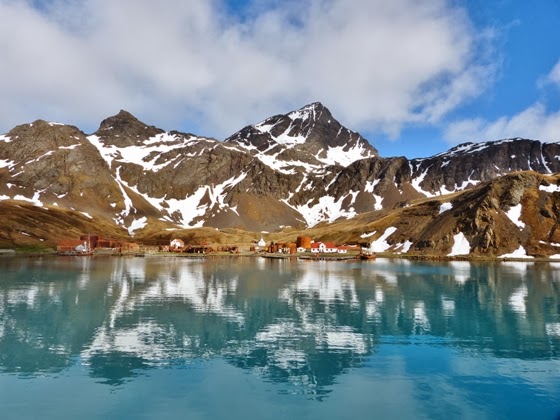
Around 8:00h FRAM reached the harbour from Grytviken, the first whaling station, founded in 1904 by Captain Carl Anton Larsen.The weather was still glorious, no wind but lots of sun.

View over Grytviken; FriedaPhoto
After a short lecture about the rat eradication on South Georgia, given by two ladies from the South Georgia Heritage Trust, we went ashore. It was a landing where we got many information and impressions about the history and the wildlife on this unbelievable great island.

Old whaling vessel Petrel; FriedaPhoto
The hikers from Maiviken arrive in Grytviken; Photo: Steffen Biersack 
The church in Grytviken

Mount Sugar-Top; FriedaPhoto


Please look at our pictures. Perhaps you will understand that we are more than deep impressed.