Showing posts with label Benno Freidling. Show all posts

Friday, 17 May 2013

с прие́здом!

Welcome! Welcome to Russia, to Saint Petersburg, to an ambience packed with history!

Early this morning FRAM sailed into the Neva River to go alongside the English Embankment situated directly in the heart of the old city centre. Golden cupolas and pompous palaces gave us an idea of the splendor and luxury of previous times when St Petersburg was the home of tsars and centre of the Russian Empire.  

During the morning excursion we had the opportunity to explore the daily (modern) life of this busy metropolis. We started with a stop at one of the market halls, where we found sausages, meat, fish, vegetables or fruit from the area as well as from abroad. Really delicious are the Russian honey and the pickled vegetables, we could taste them all. After this visit we started the ride with the underground, founded in 1955. The underground, called metro is really deep, and therefore the escalators are unbelievably long and quite fast. Back on earth we walked from the Admiralty over the Palace Square to one of the former residences to have a cup of tea and eat some traditional Russian cake.

In the afternoon another excursion took us to the Peterhof Palace where we saw the splendid apartments of the 18th and 19th century. Afterwards we explored the huge beautiful garden with the famous fountains - unfortunately under the typical St Petersburg rain.

Wet was also the boat tour through the channels. It was a pity that the sun which had been with us since the beginning of our trip abandoned us today, but all the passengers took it with good humor. After cruising for one hour along monumental buildings, vividly described and explained by our tour guides, we took again the bus to proceed to the Saints Peter and Paul Cathedral. Here we saw the graves of the tsars and were offered a demonstration of a Russian a capella choir.


The day concluded with an unforgettable concert in our own Observation Lounge by the State Symphony Orchestra. This was not only a wonderful end to our first day in this amazing place, but also a perfect celebration of the Norwegian National Day!


Thursday, 16 May 2013

Reval or Tallinn?


Sailing in the Baltic Sea is a real summer holiday: a calm sea, bright sunshine and a blue sky. Arriving in time in the capital of Estonia, Tallinn, in the morning all of us looked forward to leave MV FRAM and went into the town; either on our own or on an excursion. Tallinn is a beautiful old town founded in the middle age. The most prosperous period was during the time, when the town was a member of the Hanseatic League. Tallinn, with a population of 8,000 during that time, was very well fortified with city walls and 40 defence towers. Still today there are 26 towers and 50% of the wall to see.

One group went on a walking tour from the Domberg, the former upper part of Tallinn, seat of the central authority and the Cathedral.
We visited the cathedral and the Russian orthodox church of Alexander Nevskij. On our way to the lower town we followed the longest mediaeval street which led us to the House of the Brotherhood of Blackheads. We had a short break and enjoyed the performance of a dance-group.


The market-place was shown to us with the town hall in gothic style and some of us used the time to visit the oldest pharmacy in Europe from 1422. But one of the best things was just to stroll around and have a closer look into the tiny, little shops and galleries.

One group went for a bike ride in the old town and also in the younger parts of the city. On the panoramic tour we visited also the Kadriorg Palace, originally planned by Tsar Peter the Great, today a lovely baroque castle with a beautiful park. On our way back we stopped at the ruins of the former Pirita Convent dedicated to St. Brigitta and founded around 1400.

Unfortunately we had to leave the wonderful old town of Tallinn in the afternoon. But there is still the question, Reval or Tallinn? Both names are known for the capital of Estonia, but Reval is the old name given by the German knights and Tallinn is the right and today only used name.
Later on board we listened to some more lectures or enjoyed the sunshine on the deck.


Monday, 13 May 2013

The three “FIRSTs”!

What a day! To start with, it was of course our FIRST day on board. And it couldn’t be better to get used to the sea: the water was calm as a lake and the sun was shining from a perfectly blue sky.
After midday we reached our first port of call: Stralsund. It was the FIRST time ever MS FRAM visited this former Hanseatic town. On the other hand, it was also the FIRST time that the city received a cruise ship of this size! No surprise that there was big excitement on both sides. We were welcomed by gunshots from historical canons and live brass instruments music. Our Captain and some of the officers were the first to leave the ship to be greeted and later escorted by the mayor to the city hall where the Captain had the honour to put his signature in the golden book.


In the meantime, to celebrate our arrival, we were generously treated with sparkling wine at the pier. Afterwards, a boat shuttle transferred us to the main pier. From here we could explore the ancient city centre – either by excursion or on our own. Due to a wealth of well-restored buildings, Stralsund earned the title of UNESCO world cultural heritage (in conjunction with Wismar). Of more than 800 listed buildings in Stralsund, more than 500 are designated as individual monuments in the Old Town.

In addition, the original Gorch Fock lays in the harbour, now hosting a museum. For those interested in biology, there is also a huge new museum for marine life, the “Ozeaneum”, which is also very worth visiting.


Nicole's dream comes true...!


Saturday, 4 June 2011

Lost in Iceland…


…is the official motto of Iceland. And a very suiting motto as the landscapes of Iceland can make you lose your way but also because the beauty and wildness and the tenderness of the green moss reflecting in the sunbeams can hypnotize you and make one completely lost in Iceland.

We did not visit Iceland underneath a clear blue sky. Which was actually quite lucky as cloudy weather, mixed with occasional showers and sunlight gives you one of best experiences Iceland can give you. The changing colors of the vegetation in the mountains go from dark to green to silvery dark and then once in a while bright sunbeams sweep over the lava fields. That is simply magnificent.

Having arrived in Reykjavik most of us went on various excursions around the complex and fascinating areas of the southwestern region of Iceland. One cannot mention Reykjavik or Iceland without thinking of the Golden Circle, a tour which takes you to three of the most spectacular and historic places in Iceland. One of the most beautiful waterfalls in Iceland is Gullfoss, the golden waterfall, with its two cascades at right angles. The famous geyser Stori Geysir in Haukadalaur is quiet today, but his little brother Strokkur erupts every 10 minutes starting with a huge blue bubble. The third stop was at Thingvellir the former place of the ancient parliament. Since 2004 belongs Thingvellir to the world heritage of the UNESCO.
Another group travelled along the Ring of Fire in the mountains of Hengill. In this area you find huge geothermic fields, full of steam, heat and a horrible smell of sulfur. One of the highlights was the visit of the new geothermic power plant Hellisheidarvirkjun where we learned about the production of energy and the geology of the area.

Some of us took the more adventures 4*4 big wheel drive into the mountains and across small rivers. It was amazing how steep slopes the cars would be able to climb and the drivers told us that it was not even close to what the cars really was capable of. Luckily we were also driving on ordinary and gravel roads as the physical strain was surprisingly hard when we were jumping all over our seats.
Having finished our tours the cosmopolitan and vibrant capitol of Reykjavik tempted us with its cool and trendy but laidback cafés and restaurants. It is hard to believe that Reykjavik lays just a few hundred kilometers below the Arctic Circle and is in fact the most northern capitol in the World.

Now two sea days await us before arriving to the land of icebergs, sled dogs, lush fiords, the Greenlandic people and hopefully a whale or two…

Tuesday, 24 May 2011

Zeebrugge

The sea was a little bit rough in the morning after the superb day on the Channel Islands yesterday. In the morning, Anja the expeditionleader gave information`s about the day in Zeebrugge and the island of Borkum in the Framheim hall. Also a lecture was given by Carolina with the topic: “Bruges and van Eyck”. At 3 pm the MS FRAM reached the city of Zeebrugge. Zeebrugge is the outer port of Bruges in West Flanders province. It is connected with Harwich, England, by a rail ferry. Zeebrugge was developed approx. 1900 to replace the silted-up port of Bruges. It is Belgium`s most important fishing port and the wholesale fish market located there is one of the largest in Europe. Hurtigruten offered a shuttle bus to the tiny seaside resort Blankenberge. The other guests participate in two excursions: Romantic Bruges & Canals, Bruges & Belgian Chocolate Demonstration and Outskirts of Bruges.
It took about 30 minutes by coach to reach the capital and largest city of the province of West Flanders in the Flemish Region of Belgium. The historic city centre is a World Heritage Site of UNESCO. The city`s population is 117,000. Along with a few other canal-based northern cities, such as Amsterdam, it is referred to as “The Venice of the North”. The walk through the city was wonderful but the highlight was a canal tour along the serene waterways of this romantic historical city.
Do not forget, Belgium is also famous for beer, chocolate, waffles and French fries.
All guests enjoyed the stay in Zeebrugge and surroundings very much. We set sail again at 8 pm.
Later on our host Günther Meyer had an interview with the ship`s Captain Arild Hårvik, the Hotel Manager Bjørn Erik Julset and the Expeditionleader Anja Erdmann in the Observation Lounge.

Monday, 23 May 2011

Guernsey and Sark

During the night the MS FRAM was drifting nearby the Channel Island of Guernsey. The island is a British Crown Dependency in the English Channel off the cost of Normandy. The name of the Channel Island is of Viking origin. The second element of Guernsey `ey` is Old Norse for the Island, the first element is uncertain, traditionally meaning “green”, but perhaps rather representing a Viking personal name, possibly Grani`s. Today Guernsey lives off Financial services, such as banking, fund management, and insurance. Tourism, and horticulture, mainly tomatoes and cut flowers, especially freesias, have been declining. Light tax and death duties make Guernsey a popular offshore centre for Private equity funds.
At 8 am we started with the transfer from the ship to town. It was still windy but all passengers were brought safely to a floating bridge in the harbor of St. Peter Port, the main city of the island. To excursions were offered. One was a bus round tour mainly on the southern part of the island and the other one was a walking tour in the city of St. Peter Port and to the Castle Cornet. Both excursions took place in really good weather conditions.

In the afternoon just before 2 pm the MV FRAM reached the nearby tiny island of Sark. The island has a population of about 600. The economy depends primarily on tourism. Sark consists of two main parts, Greater Sark and Little Sark to the south. Again we had to use our fantastic Polar Cirkle Boats. The landing side is a tiny natural harbor with high cliffs to all sides. Tractor-busses drove the passengers up to the village. Many guests went aboard a horse drawn carriage for a tour of the island. There are no cars on the island, only superb scenery. Some guests enjoyed an independent cycle tour to see Sark`s parish church, the beautiful garden of Seigneurie and the spectacular coastal scenery with numerous bays .

It was a particulary nice visit on Guernsey and Sark.


Friday, 28 May 2010

Music, Waves and Whales

What a amazing morning. The last day of  our Event-Cruise  was a highlight pure. Nyksund, the old
fishing community that came to fame when it was so abruptly depopulated. The houses cling on the
rock knolls around the harbour.


Red, greeen an grey wharf buildings are clustered together, their paint peeling. More than a few are one the verge of total disintegration. Inside the village itself, all is eerily calm-even on a fine summers day, like in the beautiful morning today.


Finally, there is some activity, as tourists of different nationalities amble betweeen the wharfs and houses with their cameras ready to captures images of this former ghost town. This are also the pictures on the day when all passengers of MV Fram qonquer Nyksund. The condition of the village bears witness to this-during the hectic tourist season, there is a melancoly undertone always present. And in the end of our walking through Nyksund there was a surprise for our passengers.


There was a classical concert in the museum, a former storehouse on the harbourside. Music from Debussy, Hugo Wolf, Arvid Hansen and Edvard Grieg with norwegians artists-Marit Nygård (Piano) and Synne Meland (Songs). A unique athmosphere on this historical place.

After leaving Nyksund we headed for the Vesteralen Islands. To the West the island of Andoya there is a little rock called Bleikoya, which is home to tens of thousands of seabirds. Kittywakes, cormorants, alks, puffins, skuas and sea eagles were observed in great flocks turning around Bleikoya and feeding right offshore. However, because of the rocky approach, we couldn't get as close as at Runde.


So in the end we headed North-Northwest for the deep sea canyon off Andenes. This is where the male sperm whales dive to the sea floor, as deep as 1.000 metres below the surface, to catch squid, their preferred food. Their females prefer warmer temperatures of more than 15 degrees C and stay in the Carribbean, around the Azores, Madeira or off the Canary Islands. Shortly before reaching the canyon, the helmsman exclaimed "there she blows!". 


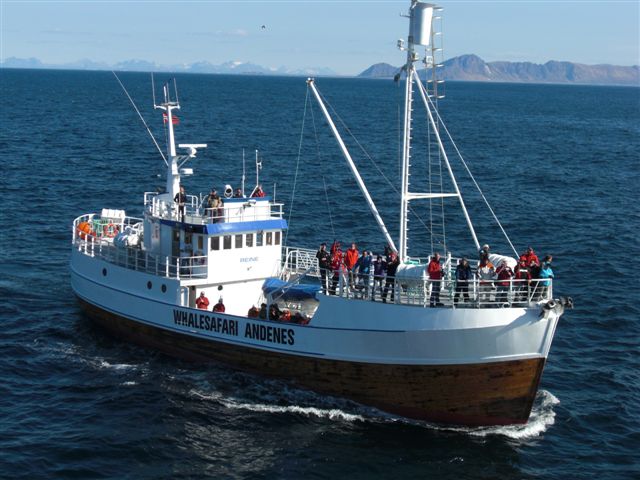
We joined the whale-watching vessel from Andenes, MS Reine, which is equipped with an under- water microphone and via radio channel 16 were informed when strong clicks were heard, indicating a surfacing whale. We were verz lucky: our first whale surfaced right in front of us at 1 o'clock from our course, heading for us. After breathing about 30 times, the head of the whale came higher up, the animal took one last breath and then curved its back: "diving!". Then the fluke came up as the whale headed down for another vertical dive. Everybody took a photo of the tail, which for sperm whales is like a fingerprint. We will be able to identify the animal from the Andenes sperm whale catalogue.


The day ended in Bjarkoya, the settlement of the Viking Thore Hund, where we were met by real vikings and their families.

Tuesday, 18 May 2010

Norwegian Flag and Harris Tweed


Today we celebrated the Norwegian National Day on board the MV Fram. It is an important
happening in the homeland of our ship. A big parade by the crew and guests marched along the hallways and through the entire ship with music, flags and singing the Norwegian hymn. Later on the dinning hall was opened with a big Norwegian buffet and from 10 pm Friederike presented the vegetable and icecarving-show of our philippino crew.
But we are faraway from Norway. In the morning we visited Lewis, the largest island of the
Western Isles or Outer Hebrides of Scotland. Lewis contains the only town Stornoway, and three
quaters of the population of the Western Isles. Here in Stornoway we docked and started
our excursions to the importent gaelic points of the island.
The Callanish Stones are situated near the village of Challanish. Construction of the site took place between 2900 and 2600 BC, though there were possibly earlier buildings before 3000 BC. The 13 primary stones
from a circle about 13 m in diameter, with a long approach avenue of stones to the north, and shorter
stone rows to the east, south, and west. The overall layout of the monument recalls a distorted Celtic cross.
Another importend attraction are the Black House a traditional type of house which used to be common
in the Highlands of Scotland and the Hebrides. The buildings were generally built with double wall dry-stone
walls packed with earth and wooden rafters covered with a thatch of turf with cereal straw or reed.
The floor was generally flagstones or packed earth and there was a central hearth for the fire.
There was no chimney for the smoke to escape though. Instead the smoke made its way through
the roof. The black house was used to accommodate livestock as well as people.
People lived in one end and the animals lived  in the other part with a separation between them.
A lot sheep of different breedes crossed the narrow streets- time to talk about Harris Tweed. It is a type of tweed that is only from the Outer Hebrides.Harris Tweed is a fabric made of pure virgin wool that has been dyed and spun and was woven by hand by residents of the islands of Lewis, Harris, Uist and Barra in their homes. Tweed has been produced since ancient times in Scotland. During the time of the industrial revolution it became uneconomical to weave by hand  and Looms replaced the Loom. Only on the remote Outer Hebrides, at that time already known for the quality of their tweeds, manual production methods have been retained. But there was no time to buy the fantastic tweed products with the different colores.
So we look for shopping time tomorrow, the last port on our voyage.

Friday, 14 May 2010

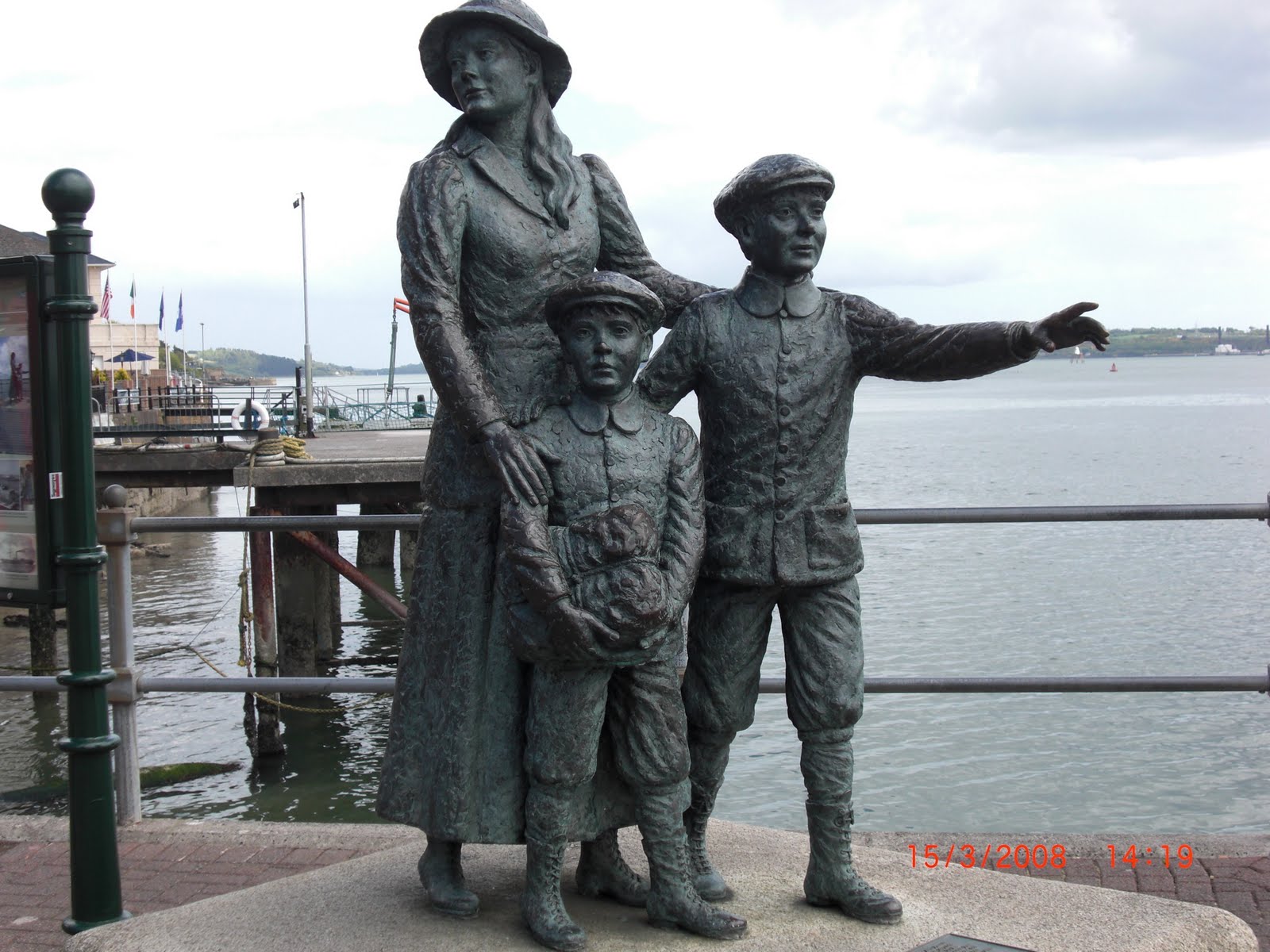
Cobh - on the footsteps of the HMS Titanic


In the morning we reached the harbour of Cobh, former Queenstown, Ireland. This was the last port of the HMS Titanic when she stopped here on her maiden voyage to bord and disembark passengers. She was owned by the White Star Line. The office building from this company is still to be seen in town. Also the pier from where the over 100 passengers where brought by tender boat to the ship is still to be seen. As harbour facilities at Cobh were inadequate for a ship of her size, the Titanic had to anchor offshore.  At the waterfront of Cobh still the same houses, same buildings remains as 98 years before. Only the cars were not present at that time. Lots of people were gathered in the harbour street to wave good bye to the 2,240 people on bord the unsinkable liner. The stop was limited to only 1 hour and 18 minutes before they heaved the anchor and left the last stop over in Cobh and sank on the 15th of april 1912 on her way to New York.