Showing posts with label Verena Meraldi. Show all posts

Tuesday, 10 November 2015

Grytviken

After a great but cloudy day yesterday, we awoke to bright sunshine as we arrived to Maiviken (May Cove). There we dropped off our intrepid hikers who were to make their way up and over from Maiviken to Grytviken. The hike was spectacular with sun and little wind and an added bonus was the sighting of the endemic South Georgia Pipit at the beginning of the hike.

Image by Verena Meraldi
After the massive rat eradication program that just finished on South Georgia, the pipits are coming back. Rats eat the eggs and chicks of the pipits and many of the smaller seabirds breeding on the island. Although the eradication program has been completed, you can still contribute to the funding shortfall by going to the South Georgia Heritage Trust website: www.sght.org.

Yesterday we visited the whaling station at Strømness, which was off-limits to us because of asbestos risk and because the buildings are very unstable. Today in Gryviken we were able to actually walk through the remains of the Norwegian whaling station there. A few years ago the South Georgia government and the South Georgia Heritage Trust cleaned up the station of hazards with the result that access is now possible. By the way, a 'gryt' is a try pot (from Norwegian): a cauldron used to boil the seal blubber in the early days of Antarctic exploitation. To 'try-out' is render the oil our of the blubber. 'Vik' is a bay in Norwegian. 

Here you can see various tanks and generators in the whaling station and in the distance, the old church dating from 1913.


The chains used to pull the dead whales up the flensing plan lie in a pile.


A Wandering Albatross mount peers out the window of the Carr Maritime Gallery towards the Fram anchored offshore. The gallery is part of the museum at Gryviken.


An Antarctic Tern hunting for food need our landing site.


Some beautiful lenticular clouds developed of the mountains near Gryviken as we left.

And like our Falklands tour, South Georgia has just whizzed by- time has a different meaning in these places. Now we will spend a couple of days sailing in the Scotia Sea south and west to the Antarctic Peninsula. 

Tuesday, 25 November 2014

In the realm of the Gentoo

Our two destinations today are home to colonies of Gentoo Penguins. The first, located in the fairly called Paradise Bay and on mainland Antarctica, is also occupied by the few building of the Argentinian Brown Base, once called Almirante Brown Station. 


A Polar Cirkle Boat cruising offered some of our guests the opportunity to have a closer look at the icebergs and wildlife in Paradise Bay. 


The rest of us admired the views from top of the approx. 100 m high hill right behind the station, and remembered our childhood days by sliding our way down. 


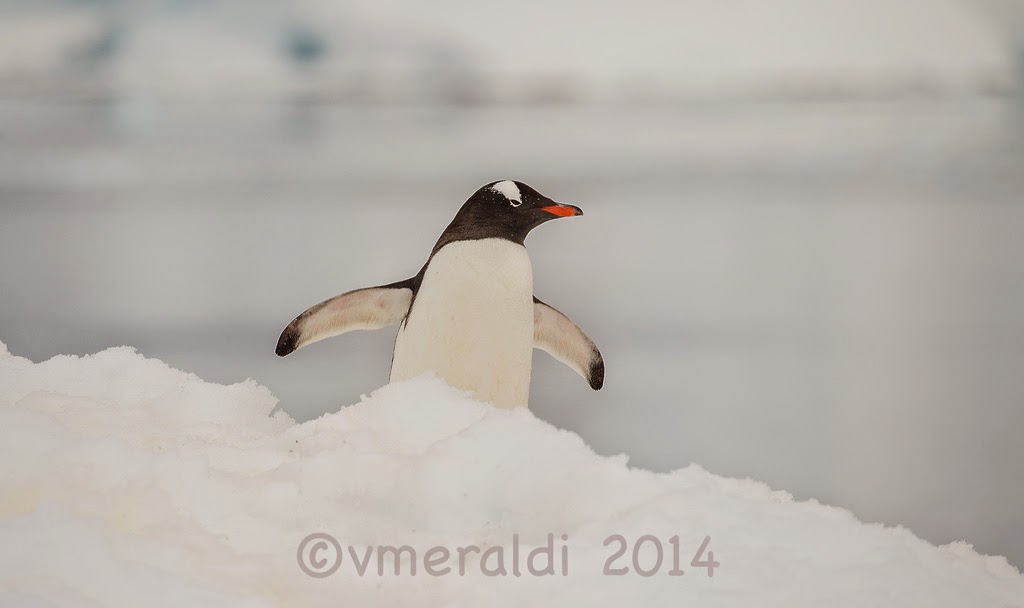
The Gentoo Penguin colony near the settlement has increased in the last few years, now numbering some 100 individuals. They were, like many other penguins in the same area, patiently waiting for the snow to melt in order to build their nests and start the breeding season... 


But they are not waiting with their wings crossed! We witnessed a lot of “practicing” during our stay there. 


Blue-eyed Shags also nest on a nearby cliff, we saw them flying all around the station carrying nesting material on their beaks back to the colony.


Danco Island is located in the southern part of the very scenic Errera Channel, off the western coast of Graham Land. The Gentoo Penguin colony here is bigger, with some 2000 breeding pairs, and they are distributed in two main areas. 


The first large group is located on the northwest slope of the island, and the others found their way to the very top of the island, some 170 m high. Up there, snow has melted and some eggs were already to be seen on the nests. 


Some of our very sportive guests circumnavigated the 1.6 km long island on kayaks, while others were given a nice tour comfortably seated on the Polar Cirkle Boats.


Last but not least, camp was set up at around 9pm and a lucky few could experience a night out in Antarctica. Some slept more than others, but all had the chance to hear the sounds of Antarctica in a small group and for a long time: calling penguins coming and going, curious Snowy Sheathbills flying around the campground and landing on the tents, as well as the noise of the icebergs moving with the currents.   


Saturday, 22 November 2014

Station day

We had our first landings in Antarctica today. Although is was quite cold, -4°C, and lightly snowing, there was no wind and the visibility was also quite good, perfect conditions!


We arrived at King George Island at around 8 this morning, this is the largest of the South Shetland Islands and also home to the biggest collection of scientific stations in Antarctica. Our first destination was Admiralty Bay, where two stations are located, the Brazilian Ferraz Station, and our goal, the Polish Arctowski Station.


The station is named after the geologist Henryk Arctowski, he was a member of the first truly scientific expedition “Belgica” (1897-99) to Antarctica under the command of Adrien de Gelache. The station is near the Point Thomas Antarctic Specially Protected Area, which is off limits to visitors. Here, Adelie, Chinstrap and Gentoo Penguins breed, making it a unique place for comparative studies on their breeding biology.


We had the chance to see all three species resting on the beach before their final hike up to the colony, as well as a Skua feasting on a stolen egg.


We also had the possibility to see for ourselves the living quarters of the scientists from many nationalities that spend the austral summer here.


During lunch the ship repositioned to Maxwell Bay on the western extremity of King George Island. This bay is home to Russian, Chilean, Uruguayan, Korean and Chinese Stations, and the latter, the Chinese Great Wall Station, was our second destination of the day.


It was built in 1985. This station can accommodate up to 80 scientists during summer, and the wintering team is always composed of 12 to 14 members.


The weather didn’t change much, as we arrived, snowfall was constant and the visibility very limited. But as always in Antarctica, conditions changed trough out the landing and by the end it stopped snowing and we had a clearer view of our surroundings. There is little wildlife around the station, therefore we focused on visiting the facilities and hiking up a nearby hill that offered astonishing views of Maxwell Bay.


 A little group of 15 passengers went of on a snowshoe adventure up on the Fildes Peninsula behind the station.


Thursday, 8 November 2012

We're all goin' on a summer holiday

Yes we are! It's summer down here in the southern hemisphere, or late spring by some calculations, and we are on holiday! As it happens, as your blogger scribes these words, Cliff Richard's "We're all goin' on a summer holiday" rights out in the background, hence the inspiration for the title.


Our holiday involves sailing on a ship in some of the roughest seas anywhere and visiting some of the most remote places on Earth! Some holiday you might say, but we have so far hugely enjoyed our voyage south from Buenos Aires and our three days in the Falkland Islands!

Today we were in Stanley, capital of the Falklands, and its most populous community being home to about 2,300 "Kelpers". The whole of the Falkland Islands contains only 2,500 people, excluding the military. Quick arithmetic, indicates that there are more passengers on the Fram than there are living in the Falklands outside of Stanley!


Activities today were varied. Some relaxed in town, exploring the shops, having a bite to eat over lunch, and chatting with the very friendly local people. Others decided to take one of three excursions to Bluff Cove, around the bay on a nature walk or on a tour of Stanley. Overlaid on the day was the weather, including rain and 40 knot winds. All in all it is fair to say we experienced the Falklands in all its glory!


We set sail from Stanley late afternoon. As we left dockside the Fram's bow thrusters had to push hard against the gale-force winds, which has decided on their own that we should stay an extra day! However, the Fram was too powerful and we were released into the harbour and then out into the open Scotia Sea on a heading east-south-east to South Georgia.