Showing posts with label Peter Szivolt. Show all posts

Saturday, 9 May 2015

Sailing The North Sea

Our day at sea started with a few Bridge Visits on deck 6. Guests were able to sign up and meet us in groups so we could visit the Bridge and ask the captain all sorts of questions. It is a very interesting experience and a unique chance to get a look "behind the scenes".
 
Our extended lecture program gave everyone the opportunity to learn about the principles of navigation, the North Pole, the Fram, the Norwegian outdoor life, and a lecture from our guest professor lecturer entitled "Beneath the Waves".
On our way to Dover we sailed passed dozens of big oil rigs and wind mills. The North Sea obviously still has plenty of available resources like fossil fuels, wind and wave power. 
The captain also held a farewell cocktail in the Observation Lounge as it was our last day on this trip. After a toast, we all sang a song together which is always a very nice way to end the trip together.
After a last dinner in our restaurant, it was time for some last packing, maybe a drink in the Qilak bar and off to bed. After all, tomorrow we will be in Dover where it is a new start for both the passengers and the crew!

Friday, 8 May 2015

Dressed in White (or how the German Navy got Foghorns...)

We have spent many days inside the looming shelters of the most spectacular fjords of Norway. One of the agreeable side effects was the calmness of the waters; you could literally play a round of mikado any time you liked.
Well, last night we had a long stretch to take along the outside of the Norwegian coastline, and the difference is quite noticeable, things are moving, people are swaying. But then again, this is a ship, isn’t it…?
In the morning we take a spectacular left turn around Karmøy Island through a narrow passage in order to get to our destination, Skudeneshavn. The ice age-rounded rocks are sticking out of the water on both sides of FRAM, crowned by cute white houses, whose owners can look right onto our breakfast tables.
And on the outside of this impossible passage sit the lighthouses, of paramount importance in the olden days to guide the vessels into the safe embrace of Skudeneshavn.
Today these lighthouses have lost their significance, some of them are even privately owned as a homestead. This is probably the pinnacle of a home with ocean view.
Under the morning sun but with a fresh breeze we go to pier, ready for the last set of excursions.
Named after a certain type of sailboat, the village of Skudeneshavn made it to considerable fame in the times of the great herring catch. Fishermen came not only from Norway but from all over the world, and they gave their cultural input to the otherwise plain white wooden architecture of the place.
Whereas the modern city of Skudeneshavn has about 3200 inhabitants, including the new built city quarters that didn’t exist at the time, every peak season in the early 19th century saw over 40.000 men arriving, creating a huge lodging problem. Nevertheless, the industry yielded so much money that people were willing to endure all kinds of hardship for it.
Today the old town of Skudeneshavn is the best preserved historical town of Norway, a bright white gem with narrow alleys and adjacent wharfside warehouses. It is even a special occasion today on the 8th of May. Norway celebrates Liberation Day, commemorating the end of the Nazi oppression, so there is Norwegian flags all over the place.
Even the word picturesque needs to be stretched to its extreme if you ever try to describe the peaceful, film-like, romantic atmosphere of this place, with the neat gardens, the cosy coffee shops, and the artistic carvings on doors and fences.
The people of Skudeneshavn are proud of their heritage and more than happy to answer questions or help to reenact the olden days. 
Original stories have happened indeed: On one of his many visits to the country of his heart, Norway, the German Emperor Wilhelm encountered a man in Skudeneshavn who just made a funny invention: Ole Christian Hansen made strange tubes out of metal that could produce an enormously loud, deep sound - he had invented the foghorn. The Emperor was so impressed by that and saw immediately the military use for it. On the spot he ordered 40000 horns for the German Navy, quite a tall order for a happy Mr. Hansen…
The visit continues. And what can I say? The weather is really doing its best to underline the pretty features of the place; after a short, biting hailstorm in the morning the sun comes out and shines through the washed air of the island of Karmøy, bringing out all the beauty of the place.
The Mælandsgården Museum looks rather small from the outside, but it is a true treasure trove, curated with the people’s full heart, in order to really bringing the past times as alive as they can be.
After a comfortable, beautiful day in paradise it is time to get back on the ship - unfortunately, as this was the last visited place of our journey.
Good thing that the weather is not intending to make our lives more difficult than necessary, so FRAM is moving only a little. That allows for the evening program to take place as planned. The Expedition Team gathers in the observation lounge, ready to answer all possible questions that have accumulated during the trip, and the evening sees the current version of the famous MV FRAM crew show, which is well attended.


Thursday, 7 May 2015

How to "Friluftsliv" in Norway!

On the (very) early morning of Thursday, many of us were already out on the decks to enjoy the fresh air and admire the 229 meter high Feigumfossen on the southern side of the Lusterfjord.
A very eventful and sportive day was awaiting us in Urnes/Luster and Balestrand. A day filled with outdoor activities in close contact with nature, which the Norwegians would describe as a Friluftsliv day (an "outdoorlife" day). This started with a Kayak Adventure in the morning and a (somewhat) a challenging walk up to the Stave church in Urnes.
This is Norway´s oldest and best preserved stave church which still stands in its original location that offers impressive views over the village and the Lustrafjord that surrounds it. Those who joined our excursion were welcomed inside the church for a "guided tour" and were allowed to take a few pictures. Guests could also have a look inside the visitors centre that is located nearby. The 5 snakes we saw last week on the little wall not far behind the church were hiding amongst the rocks to keep warm. The sun was not as present yesterday as the week before so they did not come out as much to warm up their bodies. Only a few of us have seen the female snake that the two males were fighting for last week.

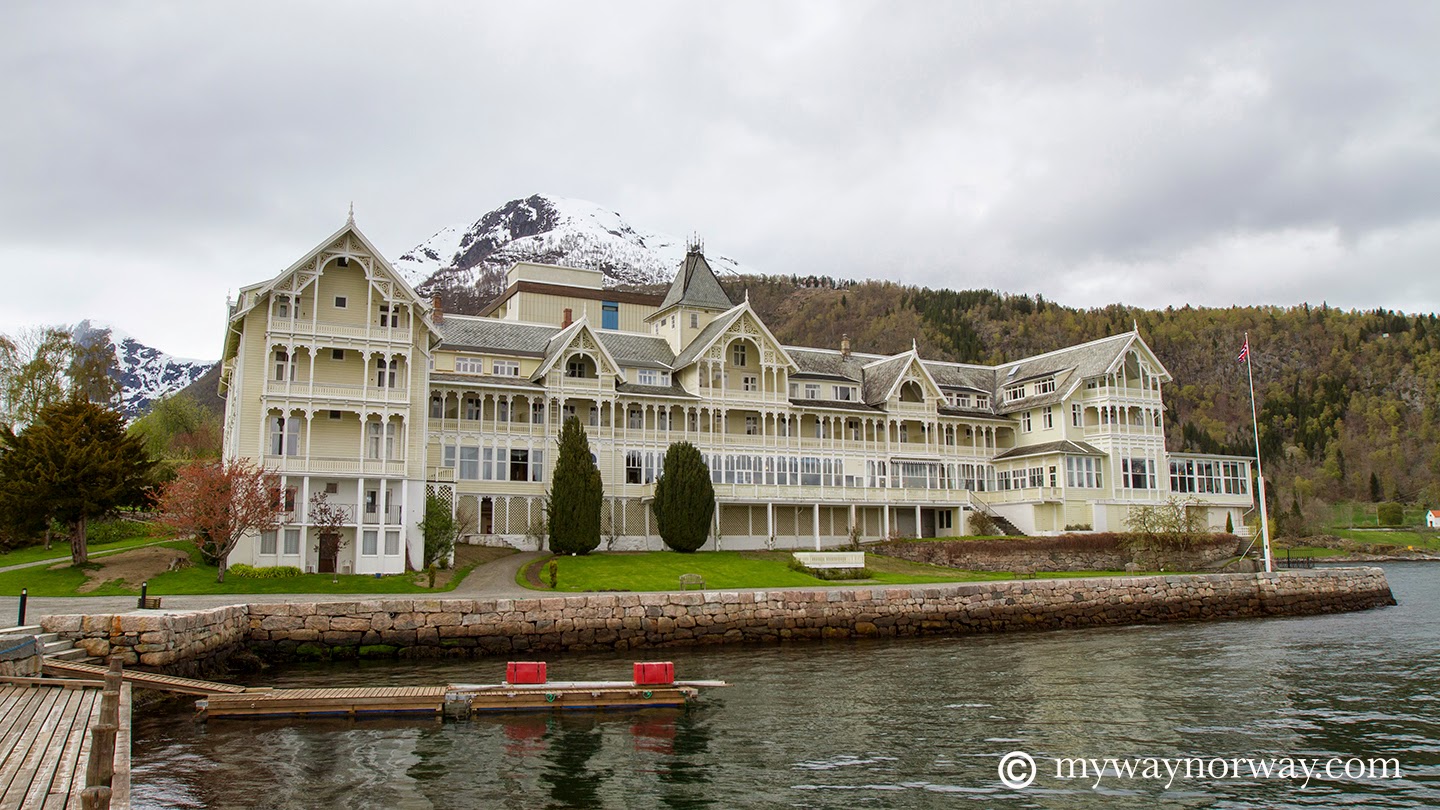
Fram arrived in Balestrand in the afternoon and we soon started our tender operations to bring everyone on the pier where we served local cheese Gamelost (old cheese) for an hour. This was also the place where two of our excursions started: The Cultural Village Walk with the Cider House and the hike in Balestrand mountains. The village walk took guests to some of the beautiful villas that the artists built here and to the Kvikne Hotel, which is Norway´s largest wooden building.
The tour also went to St. Olav´s Church, which was completed in 1897 and is more or less a copy of the Norwegian Stave churches from the Viking age.
The hike up in the mountains was not as easy as our regular hiking excursions. The track up on Balestrand´s most painted Esefjellet mountains is for adventurous people who like a challenge and the breathtaking views from the top as a reward. The winding path in the forest and the physical challenge really made us experience the Friluftsliv!

The afternoon was also perfect for an other Kayak Adventure which really put the large cliffs next to the fjord into perspective. The way back was quite challenging as the wind and the currents had picked up and pushed us back the wrong way.
During the evening, Noel, Michael and Nestor from the galley entertained us in the Panorama Lounge with a show where they carved fruit, decorated cakes with marzipan and folded napkins in the shapes of flowers and swans!
An interesting ending to a very successful day. Remember everybody, go outdoors, breath the fresh air and challenge yourselves! Live a Friluftsliv life!     

Wednesday, 6 May 2015

The Prettiest Place in the World

During the night we had the Changing of - no, not the guards (although this springs to mind immediately as most of our guests are British) - Fjord.
Although Hardangerfjord is huge, it is clearly beaten by the Sognefjord, the second largest in the world. No less than 204 kilometers it cuts into the land, through very hard rock. Gives you a fairly good idea about the power of ice.
Not only it is the longest, it has also some of the prettiest branches of them all. Several times this area has been declared the most attractive travel destination of the planet by the National Geographic Magazine. They should know.
Today is dedicated to two of them. The morning finds us hovering in front of Undredal, the “lower dale”. Funnily enough the word could also be translated into the “valley of miracles” (undre = to wonder). And in fact, something marvelous happened here, when a French lady married her Norwegian husband, moved to this place and applied all the knowledge of her country into the production of goat cheese, which already was a local speciality. So now the best of two worlds meet here in this tiny village; it is probably the best cheese money can buy in Norway.
Undredal is also the departure point for one of the most spectacular train rides in the world, the Flåmbana.
Who would think of building a train station at the very end of a deep, steep fjord…?! Well, it worked out so far, assuming you are able to make your track climb by nearly 900 meters over a mere 20 kilometers, resulting in a slope 1:18.
The construction was a smart move, as the very important Sognefjord region got connected with the Oslo-Bergen railway that stops at the top station of the Flåm rail, Myrdal. So today we let the valleys glide by the big windows, take some good images at Kjøsfossen, the waterfall that will be strong and mighty as soon as the enormous amounts of snow have melted, and wonder about the contrast between the thick snow cover up in Myrdal and the blossoming flowers down in Flåm.
While the train riders are firing their cameras non-stop, FRAM takes a gentle left turn into probably the most scenic fjord of Norway, the Nærøyfjord. 1600 meters of looming rock walls on either side, sometimes as narrow as 250 only, this is a breathtaking sight.
Although totally remote and beautifully forlorn, this place played an important role in the past, when Norwegian mail was a thing of hand-to-hand delivery, horses, carriages, and a lot of patience.
Along the southern shore of the fjord lay the Royal Post Road, a system which involved the local farmers and finally brought the mail all the way to Bergen. Not many people could read or write, and the fee was very expensive, so there was not overly much mail to be transported, but as the fjord was one of the rare ice-free spots beyond the farm of Styvi it was of grand importance.
A group of hikers is getting dropped right there at this farm, in order to take the six kilometer long walk on the Royal Road. No postcards are delivered, but a lot of sighs are heaved at the overwhelming beauty of the hike. There’s even a little surprise, as we come around the corner towards the end of it: Our chef Eirik has prepared a little campfire for us and is frying hot dogs for everyone. Good man!
Later on we all meet in Gudvangen, swap stories and images, buy souvenirs, and suddenly notice how hungry we are. And here comes the best part: In this overwhelming scenario we have a BBQ on deck, right under the waterfalls of the Nærøyfjord. Mindboggling! What’s left of the day we spend relaxing in the panorama lounge with the gentle music of our pianist Bjorn.
Another day in paradise.


Tuesday, 5 May 2015

A stroll in the Valley Of Roses

We visited the village of Rosendal yesterday, in the company of our good friend: the sun. Our guests were shuttled ashore with the help of our polar circle boats.
Once on the pier, everyone noticed the tranquillity of this place. There was a very peaceful vibe and many flowers in the fields and gardens around us. Rosendal is located on the southern shore of the Hardangerfjorden and has 768 inhabitants. The economy relies on ship building, agriculture and of course, tourism. It is most known for the Barony of Rosendal, an estate and manor which history dates back to the 1650s.

From the pier, most of our guests took a right turn into the village to visit the information centre, do some souvenir shopping, sending their post cards and head up into the valley to have a look at the stone park. Rosendal was also the starting point of our Bondhus Lake and glacier arm excursion. From the pier, guests could join a bus ride that took them to Sunndal along a small part of the Maurangerfjord. On the way they went through several tunnels and saw a big waterfall that is very close to the road.
The walk took our guests through a troll-like landscape with big boulders covered in moss and streams with little waterfalls on every corner. The impressive and serene Bondhus Lake was their target at the end of the walk.
They then headed to Ola Løa where traditional Norwegian "Lefse" and "Melkekake" was served along with coffee and tea. 

The other excursion guests could join was the Rosendal Shipbuilding & History Tour. The local guide took us to the museum of the ship building and told us about the restoration work that is being carried out using traditional techniques and assisted by modern technology.
 
Our Expedition Guide Ralf went on a little Kayak Adventure with a small group during the morning which allowed them to explore the area from a unique perspective.
The afternoon started with a cruise through the scenic Hardangerfjord. Those who were standing outside on the decks enjoyed the scenery passing by and captured nice photos. Our lecture program informed passengers about the formation of fjords, the ice & environment changes and the upcoming days and the excursions that they might join.
In the evening, we got very close to Bergen and sailed under the famous Askøy suspension bridge. Many of us where standing outside to catch a glimpse of Norway´s second-most populous city. 
We finished the day with a traditional evening in the Observation lounge where Expedition Team member Olav taught us a few Norwegian Folkdances. Many of the guests joined us and we had an amazing time together!

Monday, 4 May 2015

How to get rich with a waterfall

This voyage is named “Spring Adventure”, the latter word conveying a bit of the element of surprise in everything we do.
That certainly holds true for the weather, which really spoilt us yesterday. Today things have changed a bit, the sun hides behind a layer of grey clouds that moves visibly with the strong winds this morning. These changes are not surprising: During the night we have entered the large Hardangerfjord System, which reaches far into the high rocks of western Norway. These deep cuts in the landscape have a significant impact on the meteorological conditions, especially when they are surrounded by glaciers. In other words: Fjords can make their own weather.
Knowing this, we just put on another sweater as we go to pier in Eidfjord this morning.
This cosy village is nestled into the flatlands that come down at the head of the namesake Fjord, at the conjunction with Osafjord.
This place was so favorable for living, fishing and hunting that it has been lived in ever since there were people around.
The morning hike with Arne and Katja is a roundhouse kick in history, starting at the stout little church in town, which is connected to a strange woman:
Rike Ragna was a woman of today’s Eidfjord community who - according to the folk tales - left her husband on a small, flat island at low tide and went about other business. When the tide came back, the man drowned (seems like the tides have been much higher in the olden days…) and she was accused, well, if not of murder then at least of something nasty. Her punishment was to go on the pilgrimage to Santiago de Compostela, which she quite dreaded. Instead she offered to erect the church in Eidfjord and dedicate it to St. James. Apparently the deals was made, and today there is a drawing on her tombstone inside, where she hands over a model of the church to Saint James.
After that it is time to “go wild”, meaning taking the path along the river towards the glacier lake further up. The first flowers are out, the white bossoms of sorral, the occasional violet and clover.
The road climbs up to a high plateau, connecting Eidfjord and Osafjord.
 The valley, although over a hundred meters above the fjord level, is filled with river sand, which seems to be a bit of a riddle. But the dynamics of Earth can explain everything: After the heavy, heavy load of the last Ice Age was taken from Scandinavia’s shoulder, it experienced  a considerable uplift by simple buoyancy; still the western shores rise by about 2 mm a year.
Scattered across this platform there are a number of piles of very round boulders. We learn that these are indeed Viking graves. The Vikings were able to travel narrow rivers, as their boats could go forward and backward at the same speed, an enormous advantage not only for warfare, but trade. Often forgotten is that these proud people were not only fierce warriors but successful merchants. And some of them found their last rest right here. Who knows who was buried underneath these rocks…? Many of these graves have never been opened, so we are free to speculate.
Eidfjord is what the Norwegians call a “kraft kommune”, a power community. Believe it or not: They rent out their waterfalls to producers of hydroelectric energy, for hefty sums and under the condition that - at least during high season - the waterfalls have to be pretty and strong enough for the tourists.
So the money in these parts is literally flowing in…
Smiling at that, we carry on over lunchtime through the scenic Fjord until we reach our afternoon destinations. Yes, plural. Those who are interested to learn about ancient living styles get a boat ride to the open-air museum of Agatunet, a picturesque settlement, the houses of which have been kept resp. Restored the old way. This place breathes Norway’s past like hardly any other.
Jut on the opposite side of the fjord is Ullensvang, one of the apple-and-berry centers of the Eidfjord community. The orchards are surprisingly big, trees are squeezed in the most improbable corner.
The beauty of the place invites for a walk, and in the evening everybody returns fairly hungry.
The later evening holds a welcome surprise, a rare discussion, taking place in the panorama lounge: Guest Professor Julian Dowdeswell and our “own” Olav Orheim stage a debate about Roald Amundsen and Robert Falcon Scott, taking up the very old controversy that shook the world in the early 20th century. Tonight a public figure and polar expert from Amundsen’s country meets the director of the Scott Polar Institute. One is tempted to introduce them “and in the right corner…”
But of course, we have to gentlemen sitting here, so it is turns out to be an intellectual challenge on a high level. Glad we could witness!

Sunday, 3 May 2015

Our first day in Norway!

Yesterday morning, Fram arrived at the first stop of this trip: the city of Stavanger. It is considered today to be the centre of Norway´s oil industry.
To introduce everyone to the facts about this industry and the role it plays in this area, our guests could attend a lecture called “Norway as a Petroleum Nation” in the morning. This lecture was followed by a Kayak briefing for those who would like to join our Kayak Adventures in the Norwegian Fjords.

Fram arrived in Stavanger at noon.
We were greeted by locals standing along the shore, some even  waving the Norwegian flag! In combination with the great weather, this made us feel very welcome in this beautiful city. As soon as the gangway was down, people went exploring the city, it's picture-perfect Gamle Stanvanger (Old Stavanger), and the peaceful Breiavatnet lake in the city centre. Even though it was Sunday, some shops were open which allowed us to do some first souvenir shopping.

Our excursions started soon after arrival and guests had the chance to choose between two tours. The Stavanger Panorama Tour took us by bus from the pier to the outskirts of the city. Stops included Hafrsfjord, where a historical sea battle was fought and the Ullandhaug Tower from where we had a bird's eye view over the city, its surrounding area and the Ryfylke Fjord. The weather was a lot better than during our last trip here so we were blessed with clear views! On the way back, the bus dropped us of in the old part of Stavanger, so we could see the more than 150 well preserved wooden houses built at the end of the 17th century.
From there we went to the impressive Stavanger Cathedral which was built out of stone in the 12th century by Bishop Reginald from Winchester, England.
The second tour, the Walk in the Old Quarters also took us from the pier to the old Stavanger but by foot. This allowed us to learn more details about the city itself and historical buildings on the way. Our local guide Bernt even showed us some very interesting things that barely anyone notices when walking through this city. We for example got to see a staircase exclusively built for ducks to be able to come out of the water during spring when they have chicks, who would otherwise not be able to climb on shore. Bernt also told us that when the police isn't too busy, they come to this place to escort the ducks safely across the streets! One of the stops on this walk was Stanvanger's Canning Museum where we were able to see how (for example) fish was canned and exported to over 40 countries in 1920. We even had a little tasting session at the end of our tour, which was very nice.

 The good weather and the friendly locals made this Sunday a big success. Everyone got back on board with a big smile and ready for our Dinner Buffet in IMAQ Restaurant.
Our evening consisted of sailing back and forth in the scenic 42 km long Lysefjorden. The weather was clear enough to see the two top attraction of this fjord that are also amongst the most visited tourist attractions in Norway. One is called Preikestolen.
It consists of a steep cliff which rises 604 metres (1982 feet) above the fjord with an almost flat top of approximately 25 by 25 metres (82 by 82 feet).
The other one is a boulder located in the Kjerag mountain and called Kjeragbolten. The rock itself is a 5 m³ glacial deposit wedged in the mountain's crevasse. It is a very famous photo spot for tourists.


We were all standing outside on the decks to admire the scenery with perfectly clear views and almost ideal lighting for pictures. It was a great ending to our first day in Norway and we are very much looking forward to the next ones!